
Feature-photo by Thomas Bormans on Unsplash
Belgium is a wonderful country for relaxed hiking, yet it is still off the radar for many hikers. You can explore beautiful forests and high moors or stroll along the coasts and through historic places. If you want to give it a try, you will find all the necessary information in this article.
Note: Some of the links on this website are affiliate links (marked with *). This means that we receive a small commission if you make a purchase through these links – at no extra cost to you. This helps us run the website and continue to provide high-quality content. Thank you for your support!
Belgium has a very mild climate. You won’t find extreme temperatures in summer or deep cold in winter. This means ideal hiking weather from spring to around the end of October. And if you don’t mind snow and ice, you can keep hiking through winter.
The lush greenery comes with a lot of moisture, though, so it’s essential to always pack good rain gear.
Hiking Trails in Belgium
How many hiking trails are there in Belgium?
Belgium is well-developed for hiking. Various long-distance trails (GR) crisscross the landscape, and several European long-distance trails also pass through Belgium: E2 (through Flanders), E3 (through the Ardennes), E9 (along the coast). The entire network of marked hiking trails covers approximately 10,000 kilometers. These trails pass through the country’s diverse landscapes, from the gentle hills of the Ardennes to the flat coastal plains. In addition, there are numerous local and regional hiking trails that offer additional opportunities for hikers.
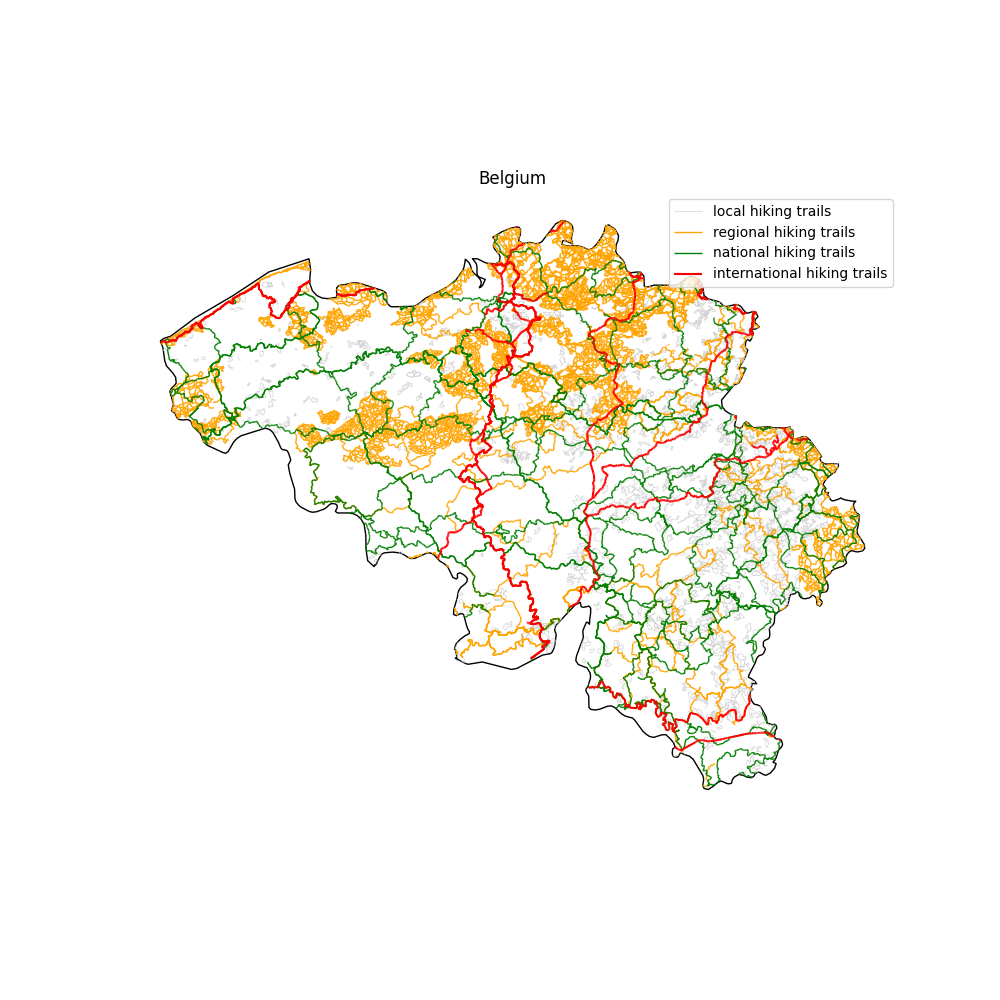
Analysis of the hiking trails in Belgium entered in the OSM database.
What is special about hiking in Belgium?
Wallonia, with the forests and gorges of the Ardennes and the high moors of the Hautes Fagnes, is particularly popular for hiking holidays.
There are also interesting hiking opportunities on the coast. Flanders, with its flatter river and polder landscape, is usually less popular with hikers but more popular with bike tourists. Nevertheless, the range of hiking trails is plentiful.
Fairly popular in Belgium and particularly interesting for stationary hiking holidays are the frequently encountered hiking node networks. These don’t have specific trails marked but rather intersections of hiking trails that are marked and signposted as nodes. Each hiker can then plan their day or multi-day hike according to their own preferences.
The Most Popular Hiking Trails in Belgium
- GR 5 (Grand Randonnée 5): The GR 5 is part of a European long-distance hiking trail that runs from the North Sea to the Mediterranean. The Belgian part is about 300 km long and crosses the Ardennes, a region known for its dense forests and hilly landscapes.
- GR 12 (Amsterdam-Paris): This trail connects Amsterdam to Paris and passes through the Belgian regions of Flanders and Wallonia on 200 km of its approximately 1200 km. It offers a mix of urban and rural landscapes. Explore historic cities like Brussels and enjoy the peaceful forest trails.
- GR 129 (Dwars door België): The GR 129 leads 500 km across Belgium from Bruges in Flanders to Dinant in Wallonia. It offers a great opportunity to enjoy the charming towns and the gentle landscapes of the Ardennes.
- GR 573 (Vesdre and Hoëgne): This trail follows the rivers Vesdre and Hoëgne for about 165 km through the Ardennes and is known for its natural beauty and peaceful surroundings.
- GR 16 (Sentier de la Semois): This hiking trail follows the course of the Semois River from its source to its mouth, passing through some of the most beautiful parts of the Belgian Ardennes. Spanning around 200 km, it is a treat for all lovers of river landscapes and forests.
- GR 412 (Sentier des terrils): If you’re looking for something completely different, hike the GR 412 or a section of it. This trail stretches nearly 300 km over thousands of slag heaps from 800 years of coal mining. Some of these slag heaps still have enough coal content to ignite spontaneously and are closed, but most are extinguished and host a unique flora and fauna.
These trails offer not only spectacular landscapes and a rich variety of flora and fauna but also insights into Belgium’s culture and history. They are ideal if you want to experience Europe’s natural beauty in a compact format.
Where can you sleep while hiking?
Belgium offers a good mix of accommodation options for hikers, from hotels and holiday homes to charming guesthouses, similar to bed & breakfasts, and other lodgings ideal for weary travelers. Hotels and guesthouses are often located near popular hiking routes, providing a comfortable and convenient place to rest after a day on the trail. Holiday homes are ideal for groups or families looking for a more private setting, often complete with kitchen facilities and scenic views.
For those traveling with tents and seeking a more adventurous experience, Belgium’s campsites offer great facilities, often surrounded by nature and equipped with amenities like showers and communal kitchens. For a true wilderness experience, a handful of legal trekking campsites provide a unique opportunity to camp in nature, often nestled in the heart of forests or by rivers, perfect for hikers looking for a more secluded retreat.
However, it’s essential to note that wild camping is generally prohibited in Belgium and closely monitored, particularly along the coast where nature conservation is a priority. Being mindful of this ensures you respect local regulations and help preserve Belgium’s beautiful landscapes for future adventurers.
What Equipment is Needed?
You don’t need much specialized equipment to hike in Belgium. The usual trio of shoes with good grip, comfortable, quick-drying hiking clothing, and a well-fitting backpack is a good start.
This trio should definitely be complemented by a good set of rain gear, as rain is always to be expected. On the coast, the rain jacket might also serve as wind protection, or you should have a separate windbreaker in your backpack.
Otherwise, as usual, you only need sunglasses, a hat, and sunscreen in the summer (especially if hiking along the coast), and in the winter, you should pack your winter hiking gear. Snow and ice are to be expected, particularly in the Ardennes, so you should be suitably equipped.
How to Replace/Supplement Equipment?
If you lose or break some of your gear in Belgium, you’re in good hands. Outlets of the outdoor market leader A.S. Adventure are spread across the country, and Decathlon, Bever, and other retailers are also available and usually not far away.
If you don’t find what you need, the internet is always an option. All the major retailers have online stores and are quite fast in shipping. You should, of course, check the exact delivery times, but packages often only take 1-2 days to arrive.
You can have your packages delivered to a convenient and open parcel shop or pick-up point. Alternatively, you can ask at one of your next booked accommodations if they can accept a package for you. If you ask politely in advance, this is usually not a problem. Just make sure to plan enough buffer time in case things don’t go as expected.
Provisions: Notes on How to Get Food on Your Hike
Belgium is one of Europe’s gourmet countries. If you want to sample the 1,000 varieties of beer, you’ll need some substance in your stomach. And as a hiker, you’re lucky to be able to indulge in Belgium’s specialties without worry: the calories from Belgian chocolates and fries (with and without mussels), waffles and speculoos, stoofvlees (a stew), and Ardennes ham will be walked off in the coming days.
To stock up on provisions, it’s usually best to head to a supermarket in the next town you pass through. You’re rarely far from one. Shops in Belgium are generally open from 9 am to 6 pm and are closed on Sundays. If you’re unlucky, you might find yourself facing a closed door during the lunch break from 12 pm to 2 pm.
In rural areas, you will occasionally find convenience shops in smaller towns called “nachtwinkels” or “avondwinkels,” or small stores attached to gas stations from major supermarket chains. Here, you can usually find something to eat until you find an open supermarket that carries your preferred products. These small shops are not always bound by opening hours and may also be open on Sundays, holidays, and in the evenings.
In many towns, you will still find weekly markets where you can stock up on local foods and baked goods and discover new things.
In the Ardennes, there are several huts and shelters with attached kitchens where you can have lunch.
Along popular hiking trails, you’ll find restaurants, bistros, and cafes where you can stop for lunch or find a late breakfast or early dinner (but not before 5 pm). Most restaurants and cafes are closed on Sunday evenings and Mondays, and many keep their doors shut on public holidays too. So check your travel plans to see when and where you might encounter closed doors and how you can cater to yourself.
Drinking – Tips for Water Supply on the Go
In Belgium, it’s generally best to replenish your water supplies at the tap. Tap water is of good quality, and if it hasn’t been sitting in the pipes for hours, you shouldn’t have any worries.
I would advise against using surface water (streams, lakes, rivers) with or without a filter. Belgium has a history of several centuries of mining and agriculture, which means that even in seemingly pristine forests, there could be traces of long forgotten chemicals in the water that no portable water filter can handle.
Brief information for your journey
Language: Dutch and French, mostly
Communication: Primarily French or Dutch. In the tourism sector, you’ll usually get by well with English. In case of need, Google Translate or the Deepl app can be helpful.
Currency: Euro
Payment methods: Mostly credit or Maestro cards, often cash, though less common than in Germany
Time zone: CET & CEST (Central European Time and in Summer Central European Summer Time)
If you want to travel by plane, you’re most likely to land at Brussels Zaventem. However, international flights also arrive at Liège and Brussels South Airport Charleroi, located south of Brussels.
Belgium is also well-connected by train. The Thalys connects Belgium to major cities in France, the Netherlands, and Germany. High-speed ICE trains provide routes from Germany, and Eurostar offers convenient travel from the UK. In addition, there are intercity trains and night trains from various European cities that stop in Belgium, making it accessible from different parts of Europe.
Eurolines and FlixBus also serve destinations in Belgium.
Public transportation is quite well-developed in Belgium. A dense railway network covers the country and is operated by SNCB/NMBS. You can reach almost any city by train, and it’s faster than the bus. And where the train doesn’t reach, buses operate.
Belgium operates on a standard 230V electrical system. If you’re traveling with Europlug-compatible devices, you shouldn’t need any adapters.
Belgium is densely populated, making it worthwhile to combine hiking with city exploration. It’s usually best to have a sufficiently sized power bank in your gear rather than renewable energy sources, as you frequently find yourself back in civilization.
Safety & Emergencies
Belgium is generally a safe travel destination. However, in tourist hotspots, you should watch out for scam artists and pickpockets. It’s wise to be wary of strangers and heart-wrenching stories. Brussels (especially Central Station, train rides and the airport) and most major tourist places share the unfortunate problem of being infamous for thieves. So you’d better keep a close eye on your gear until you are well on your hiking trail.
Belgium has a fairly high terrorism alert level, but it isn’t imminent. This mainly concerns areas where hikers rarely venture unless you’re hiking through a major city or visiting a large event. You can plan your trip confidently, but, as always, keep your belongings safe and stay alert.
You don’t have to worry about encountering dangerous wildlife in Belgium. Although wolves have returned, you must be very lucky to come across one.
It’s a different story with wild boars. If you come across a herd at dusk, especially a sow with her young, it’s best to retreat calmly and make yourself known by speaking quietly. Usually, the herd will then move away, allowing you to continue hiking. If not, it’s better to find another path.
Besides that, you should mainly watch out for ticks, as they can transmit Lyme disease in Belgium.
For plants, follow the usual rule of not touching anything unless you know it well and can identify it safely. The giant hogweed, with its distinctive white flower clusters and height of 3-4 meters, should definitely be avoided. It can cause severe skin burns if the plant’s sap gets on the skin and is then exposed to sunlight.
Despite all precautions, if you have an accident and can’t get to the hospital on your own, dial 112, the emergency number widely used in Europe. Make sure you have your European health insurance card with you and have purchased travel health insurance.
Where Can You Find More Information About Hiking?
Belgians have divided their tourism information into Walloon and Flemish websites. The Walloon website offers plenty of tour suggestions and information, and they also maintain a comprehensive presence on Komoot.
Hiking doesn’t seem to be a major theme in Flanders, but you can still find some good ideas and a lot of useful general information for your vacation.
Book Corner
Unfortunately, there isn’t much in the way of walking guides for Belgium. There is one Cicerone Guide and though it’s a bit old, it still seems to be a good starting point for planning your trip. Just make sure you verify the trails with online sources.


Belgium, a country often underestimated due to its compact size, is a true hiker’s paradise with routes that traverse diverse landscapes—from the mystical Ardennes to the gentle coastlines. In this article, you’ve learned about the most exciting hiking trails in Belgium and received tips on how best to explore them.
Beyond that, it’s worth looking beyond the borders: the hiking trails in neighboring Netherlands, France, and Germany offer other fascinating tours that can be perfectly combined with a Belgian hiking adventure. So, discover not only the natural beauty of Belgium but also the rich diversity of the surrounding countries on foot.
Happy hiking!