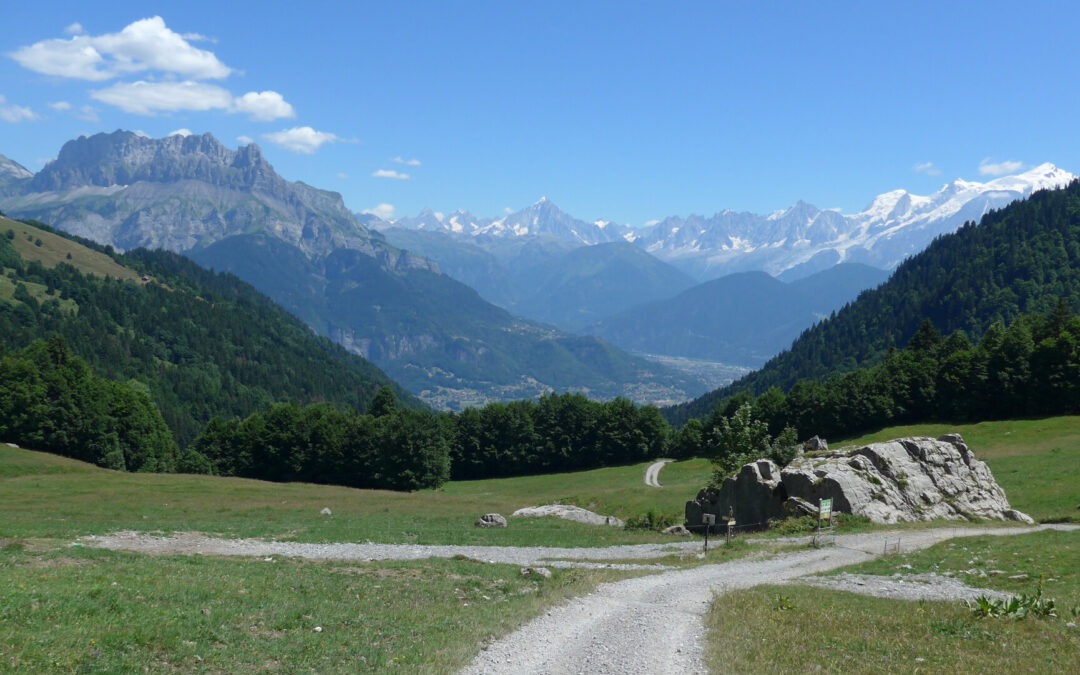
The French are one of the most hiking-crazy nations. The entire country is crisscrossed with hiking trails, offering routes for nearly every taste. Perhaps not for those who love icy deserts—though even they could explore some of the glaciers of the Mont Blanc massif. For most hikers, there are countless opportunities to combine the joy of walking with experiencing life in France and enjoying a wonderful holiday.
In France, you can hike almost all year round. If you like, you can start your spring hike from the Mediterranean coast heading north as early as late February or early March. In autumn, you can reverse the route and head south starting in October. The areas in between are best explored between April/May and October, with the typical exceptions for the higher mountains.
If you’re planning to hike in the high Alps or the high Pyrenees, July and August are your best options. Snow usually remains in these regions until June, and fresh snow often returns by September. However, if you’re not aiming for the highest peaks, you can start exploring the lower valleys as early as April, even climbing some of the lower south-facing slopes.
Brittany and Normandy are best visited in summer when it’s usually a bit drier and milder compared to the rest of the year. On the other hand, it’s better to avoid the deep south in the height of summer—not only can it get extremely hot during the day, but forest access is often restricted in July and August due to the high risk of wildfires.
In winter, many ski resorts are opening up dedicated winter hiking trails. Alternatively, you could stay by the rugged yet relatively mild coastlines.
If you’re not content with sticking to the Mediterranean coast in winter and don’t mind taking a flight, you could continue hiking in December and January in the French overseas territories. La Réunion or Martinique offer great hiking opportunities, though they are beyond the scope of this blog.
Hiking Trails in France
How many hiking trails are there in France?
The French hiking association, FFRandonnée (Fédération Française de la Randonnée Pédestre), proudly claims that they now have more long-distance trails (GR – Grandes Randonnées) than a person could hike in a lifetime. But that’s debatable! With good planning and a lot of determination, it might be possible to cover the approximately 115,000 km (71,500 miles) of existing GR and GR de Pays trails before too many new routes are added – don’t you think?
If you manage to complete all the national GR trails, which are the cross-regional routes, and the GR de Pays trails (which stay within a specific region) along with their variants and side trails, there are still plenty of local hiking and walking paths to explore. According to FFRandonnée, that adds up to another 112,000 km (69,600 miles). Just in case you get bored.
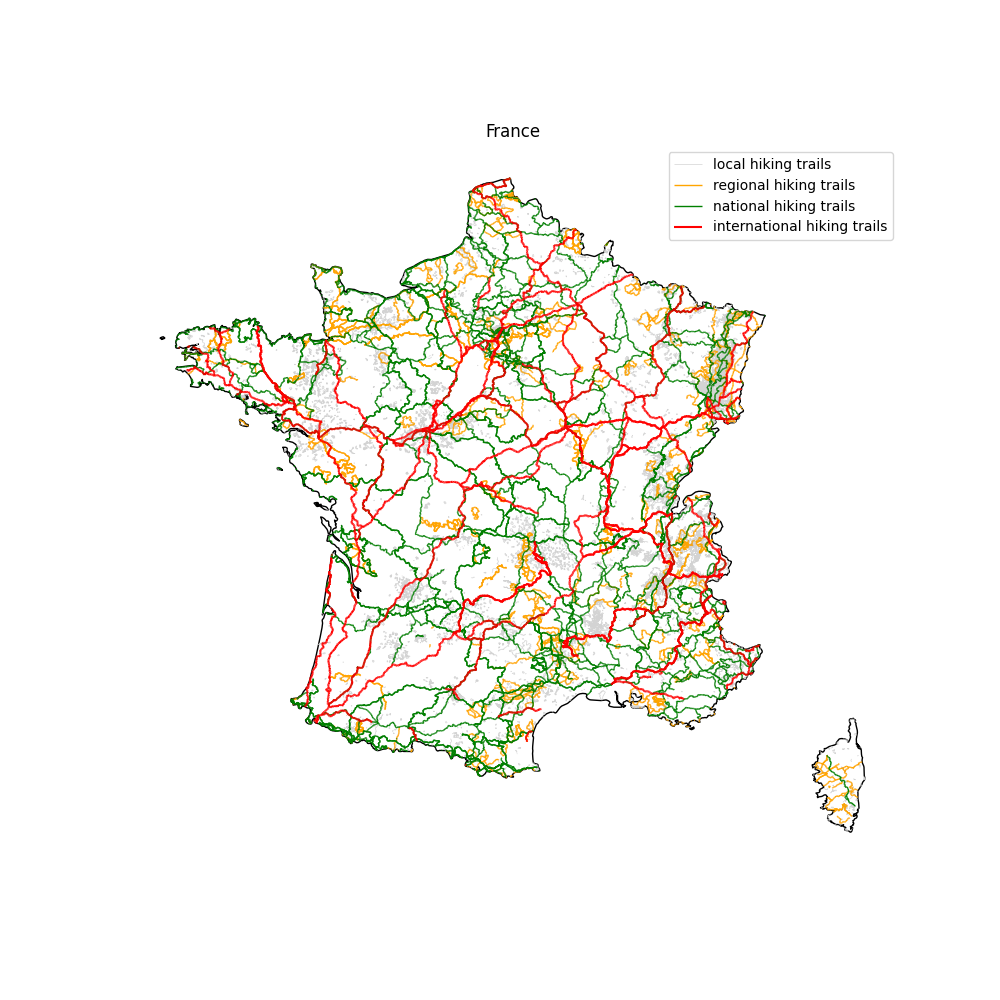
Analysis of the hiking trails in France entered in the OSM database.
The Camino routes in France
Within the GR trail network, there are also several Camino de Santiago routes that pass through France. The main routes begin in Paris, Vézelay, Le Puy-en-Velay, and Arles, where various other European paths already merge. If you start your journey in Switzerland, you’ll reach Geneva, where you can join the Via Gebennensis towards Le Puy-en-Velay.
Along these routes, more paths join in, with most converging at Saint-Jean-Pied-de-Port, where the trail continues as the Spanish Camino Francés. Alternatively, you can follow the Atlantic coast and join the Spanish Camino del Norte at Hendaye. If you prefer there is also a route closer to the central Pyrenees, where you can cross the mountains and even plan a (longer) detour to the famous pilgrimage site of Lourdes.
The Most Popular Hiking Trails in France
- GR 20 (Corsica): The GR 20 is one of the most challenging and well-known long-distance hiking trails in Europe. Spanning 180 km (112 miles) across Corsica in 15 to 16 stages, it runs from the northwest to the southeast of the island, offering dramatic mountain landscapes. The best time to hike the GR 20 is from June to September, but due to its popularity, permits are now required, and not everyone can get one.
- Tour du Mont Blanc (Pedestre): This famous route takes hikers through the French, Italian, and Swiss Alps. Covering 170 km (106 miles) in about 11 stages, the trail circles Mont Blanc, providing breathtaking alpine scenery. As a high-mountain route, it is typically accessible from late June to early September.
- Chemin de Stevenson (GR 70): Also known as the Stevenson Trail, this route follows the footsteps of author Robert Louis Stevenson through the Massif Central. The trail offers a mix of forested landscapes and rural areas and is famous for hikes accompanied by donkeys. It covers 272 km (169 miles) in 12 to 14 stages, with the best time to go being from April to October. However, beware of the pluies cévenoles, the heavy rainfalls that often hit the southern end of the trail towards the end of summer.
- Via Podiensis (GR65, – Part of the Camino de Santiago): By far the most popular of the four main Camino routes in France, the Via Podiensis offers a rich blend of cultural landmarks and natural beauty. The trail stretches over 740 km (460 miles) in 32 stages from Le Puy-en-Velay to Saint-Jean-Pied-de-Port. It is best hiked between April and October.
- Sentier des Douaniers (GR 34): Known as the Customs Officers’ Path, this coastal trail follows the entire Breton coastline for over 2,000 km (1,240 miles). It offers stunning views of the sea and passes through many historic villages. If you’re hoping for milder weather, it’s best to hike this route between May and September.
- GR 10 (Pyrenean Trail): The GR 10 runs along the French side of the Pyrenees, covering 866 km (538 miles) from the Atlantic coast to the Mediterranean. This demanding route features awe-inspiring mountain scenery and breathtaking views. It is divided into about 52 stages and can be hiked from June to September. If you’re still not done hiking by then, you can cross to the Spanish side and return via the GR 11.
These trails offer an excellent way to experience France’s natural and cultural diversity. Each path comes with its own unique features and challenges, ensuring that there’s something for every type of hiker.
Where Can You Stay While Hiking?
In France, especially along long-distance trails, there is no shortage of accommodations catering specifically to hikers.
A common type of lodging is the Gîte d’étape, which typically offers simple but hiker-friendly accommodations with bed & breakfast service. If there’s no restaurant nearby, many gîtes also provide dinner. Regular bed & breakfast accommodations are called Chambres d’hôtes and are widely available.
In larger towns, you’ll find hotels in all price ranges, and occasionally, you may come across youth hostels.
Along the pilgrimage routes, it’s common to find lodging in monasteries or church-run shelters, offering simple but often very welcoming accommodation.
If you’re hiking in the mountains, you’ll often stay in mountain huts, known as refuges, which are operated by the CAF (Club Alpin Français, the French Alpine Club). Alternatively, you can find pensions and hotels in the valley towns.
For those who prefer camping, there are plenty of campsites throughout the country. You can also find small campsites run by farmers, which offer a more personal and homely experience. If you don’t mind French-language websites, check out Bienvenue à la Ferme for nearby farm-based camping options.
Wild camping is generally prohibited in France. However, there are exceptions under specific conditions in the Alps and certain nature parks. Be sure to research the rules for your chosen hiking area or trail in advance.
What Equipment Do You Need?
For most hiking tours in France, no special equipment is required. Hiking boots with good grip, well-fitting, quick-drying hiking clothes, and a reliable backpack are usually enough.
The closer you get to the northwest and the Atlantic coast, the more important good rain gear becomes.
The closer you hike to the Mediterranean, the more essential it is to have effective sun protection that can also withstand wind. Parts of France lie significantly further south than many northern European countries, so the sun’s intensity can be much stronger than you might be used to.
If you’re planning to hike in higher mountain regions, particularly the Alps or the Pyrenees, it’s a good idea to carry trekking poles or a sturdy hiking stick. Even on regular hiking trails, you may encounter sections that are difficult to cross safely without poles, even in good conditions.
When conditions are less than ideal, things can quickly become dangerous—and that’s without venturing into proper mountaineering or via ferrata routes. We’re simply talking about steep hiking trails that can become slippery due to clay, leaves, or loose gravel. And when it comes to long descents, your knees will definitely thank you for the extra support trekking poles provide.
How Can You Replace or Supplement Your Gear?
If you realise something is missing during your hike or if a piece of equipment breaks, you’ll generally be well-supported in France.
Decathlon is a well-known French sports goods retailer with branches across the country. While they mainly focus on their own in-house brands, they’ve also started to collaborate with other well-known brands. Their in-house hiking gear is usually reliable and often a great option.
Where Decathlon isn’t available, you’ll often find a branch of Intersport nearby. Although they may not be as focused on hiking, with a bit of luck you might find something useful. In popular tourist areas, there are often independent sports shops with a good selection. Sometimes, even the large supermarkets like Carrefour, Super U, and their competitors stock items that can be useful for hikers.
If you’re truly in the middle of nowhere, online retailers can come to your rescue. Decathlon has an online store with fairly quick delivery. Other well-regarded options include Au Vieux Campeur and Alpiniste.fr, the French branch of the German retailer Bergfreunde (a good choice if you prefer ordering in German). Many other outdoor retailers deliver to France from most EU-countries (though delivery times can be long). If all else fails, Amazon.fr usually offers quick delivery – just be sure to check the estimated delivery times.
When relying on parcel delivery, it’s a good idea to check whether Colissimo (the French postal service’s parcel division) or DHL works better in your area. Often, DHL hands parcels over to Colissimo for local delivery.
Within mainland France, parcels typically take 2–3 business days, while deliveries from Central Europe can take 5–6 business days. Sending your parcel to a pickup point or relay station is common practice and usually comes with a small fee. As a hiker, this can be very convenient if you find a shop with suitable opening hours near your destination or, even better, a parcel locker with 24/7 access in a small town. Just be sure to plan ahead and allow for a bit of extra time in case of delays.
Food Supplies: How to Keep Yourself Fed While Hiking
In France, you can not only eat well, but also indulge in a wide variety of culinary delights. On Saturday mornings, local markets often offer interesting regional products, and in smaller towns, you might still find traditional artisan shops—though, like in many other countries, the decline of small shops is also noticeable in France.
For restocking your supplies, your best bet is to aim for the next supermarket located near your route. Most supermarkets open between 8:00 and 9:00 a.m. and stay open until 8:00 or 10:00 p.m.. Cooperatives like Super U have special permission to open on Sunday mornings (around 9:00–12:30 p.m.) and are a blessing for hikers who don’t pass through large towns every day.
Alternatively, bakeries (Boulangeries) are often open on weekends, at least for a few hours (usually starting at 7:00 a.m.). However, they often have one or two rest days during the week, with Thursday or Wednesday being common.
For a hot meal in larger towns, head to restaurants, brasseries, or auberges (inns). In the mountains, you will find mountain huts (Refuges) offering lunch and dinner (though not all of them do, so make sure to check before heading out).
Gîtes d’étape, pilgrims’ hostels, and youth hostels frequently offer dinner and, in some areas with limited food options, they may also provide packed lunches.
For budget-friendly options, you’ll often find sandwiches, baguettes, and other quick meals at bakeries and supermarkets.
Lunch is typically served between 12:00 and 2:00 p.m., and dinner is usually available from 7:00 to 10:00 p.m.. Many restaurants close between meal times, from 2:00 to 7:00 p.m.. Additionally, many places are closed entirely on Sunday afternoons, Mondays, and during certain holidays, so make sure to plan your meals carefully on those days.
Nowadays, Google is quite reliable when it comes to finding open supermarkets, restaurants, or cafés nearby.
Drinking Water – Tips for Staying Hydrated on the Trail
The best approach for staying hydrated while hiking in France is to fill your water bottles in the morning for the entire day—unless you plan a midday stop at a café or restaurant. Tap water is safe to drink throughout France, so there’s no need to rely solely on bottled water from supermarkets.
However, you should avoid drinking water from rivers, streams, or lakes unless you are in high mountain regions. Centuries of agricultural and mining activities have left residues that portable water filters may not always remove. Only in the higher mountains should you consider using a filter at a stream, provided you can safely access it. In these areas, you primarily need to be cautious about contamination from wildlife and grazing animals, which a good filter can handle. In heavily farmed areas, though, I wouldn’t even start talking about the water quality of natural sources…
Your safest option in France is to use the public drinking water network to refill your bottles. Early in the morning at mountain huts, hotels, or guesthouses is the easiest time. Additionally, if you take a break at a café or restaurant and make a purchase, most places will be happy to refill your water bottles if you ask politely.
When passing through a city, keep an eye out for the increasingly common public drinking fountains. These are being installed more frequently due to the hot summers, and many of them are marked on popular map apps. They are typically operational from May/June to October.
In smaller towns, you may still find small flowing water fountains (they often look like troughs along a road or rest area), which are used by locals whose homes are not connected to the public water supply. These fountains are monitored by local authorities, but since they are rarely marked as potable, it’s safest to filter the water before drinking—even though many hikers can be seen refilling their bottles directly from them. Note: In times of extreme drought during high summer, these fountains may be turned off, with affected households receiving direct water deliveries.
Be cautious with decorative fountains, which you may still encounter here and there, especially in the north (they are much rarer in the south). These are typically filled with tap water in the spring, but afterward, they are only topped up and the water is recirculated—resulting in poor water quality. If you have no other choice, you can use them as a last resort, but only after thorough filtering. Also, check whether there are green algae (not blue!) or moss growing in or near the clean water, as this indicates a lower likelihood of harmful chemicals. Still, decorative fountains should only be used in emergencies, and it’s best to search thoroughly for a proper drinking water source first. Often, there is a public drinking fountain nearby where decorative fountains are present.
In rural areas and small villages, you may occasionally find livestock troughs with a flowing water supply. Treat these similarly to the previously mentioned flowing water fountains: only take water from the inflow and filter it before drinking. Never collect water directly from the trough itself.
Quick Info for Travelling to France
- Language: French
- Communication: Primarily in French. Some regions, like Brittany and the Basque Country, have local languages, but French is understood almost everywhere. In established tourist areas, you may find people who speak English, and in Alsace, many people also speak German. Basic French phrases and a smile will go a long way. If needed, Google Translate or DeepL can help.
- Currency: Euro (€)
- Payment Methods: Credit card or cash, though cash is less commonly used than some other countries, but might sometimes still be vital in very rural areas.
- Time Zone: Same as Central Europe (CET/CEST).
By Air
France is well-connected to the rest of the world through numerous international airports, including major hubs like Paris Charles de Gaulle, Orly, Nice, and Lyon. Depending on your destination, you can also fly directly to smaller regional airports like Toulouse, Bordeaux, or Nantes. However, if you’re considering flying into Marseille, be aware that this airport has a reputation for mishandling luggage more frequently than others—so pack your essentials in your carry-on just in case.
By Train
France boasts an extensive and fast rail network, making it one of the best options for arriving from neighbouring countries.
- High-speed trains (TGV & Eurostar): Direct services connect major cities in Belgium, Germany, Switzerland, Italy, Spain, and even the UK (via the Eurostar through the Channel Tunnel).
- Night trains: Several international night trains, such as the Nightjet from Austria and Germany, allow you to arrive in Paris or Nice after a comfortable overnight journey.
Once in France, the SNCF rail network efficiently covers most of the country, with TGV trains for longer distances and regional trains for local travel. In smaller or more remote areas, local buses bridge the final gaps.
By Bus
Long-distance bus services, such as FlixBus, BlaBlaCar Bus, and Eurolines, connect France with most major European cities. Buses are often the cheapest option for travelling to France, and they can take you to destinations not directly served by the rail network. While bus journeys may take longer, they are a practical choice for budget travellers or those heading to less accessible regions.
Rail: France has a well-developed public transport system, with regional trains running frequently, often every hour. For longer distances, consider the TGV, which offers fast travel. Example: Paris to Marseille in under 4 hours – faster than flying, considering travel to the airport, check-in, and waiting times.
Buses: Long-distance buses complement the rail network where train connections are limited. In rural areas, local buses are common, and bus-on-demand services using minibuses may be available. These are often accessible to tourists for a small fee and are especially useful if you’re staying in one place and exploring the area with local hikes.
Power Outlets: Standard European outlets (Type C & E). If you have a Europlug, you won’t need an adapter.
Charging Devices: Since most hikes in France involve moving from one accommodation to the next, charging your devices regularly shouldn’t be a problem. For longer mountain treks, where huts may not always have outlets, consider bringing a power bank. However, unless you’re going multiple days without reaching a valley, there’s usually no need for extra equipment like solar panels or portable turbines—save yourself the extra weight!
Safety & Emergencies
General Safety
France is generally a very safe country for hiking. Beyond the typical risks of pickpockets in tourist areas or the occasional misplaced gear (always keep an eye on your belongings), there are few human or animal-related dangers in most hiking areas.
Animals & Plants
Wild animals: In the mountains, there are wolves and occasionally bears in the Pyrenees, but they tend to avoid people. However, if you’re hiking at dawn or dusk, be cautious of wild boars with young—it’s best to steer clear of them. In southern regions, there’s a hybrid wild boar-domestic pig breed, which should be avoided, but they are rarely an issue as they are hunted regularly.
Livestock guardian dogs: If you come across warning signs about herd protection dogs, take them seriously. You can usually pass the herd without trouble, but if the dogs seem aggressive or overly protective, consider finding an alternative route.
Venomous animals: In southern France, you may encounter vipers or scorpions. It’s wise to learn about these animals before hiking in those areas. One key precaution is to shake out your shoes before putting them on in the morning, as this can save you from painful bites. Although their venom is rarely deadly, timely medical attention is essential, especially for those with allergies.
Poisonous plants: Be cautious with plants. Although few plants have contact poison, it’s best to only handle or collect plants you can confidently identify and know are safe. Plants such as lily of the valley, foxglove, and monkshood are among the most poisonous in Europe. Many of their less toxic but still dangerous sisters grow all over France, so proper identification is crucial.
Accidents
Despite careful preparation, accidents can happen. In case of an emergency, dial 112 or 15 (emergency services). While mobile network coverage is improving, it still has dead spots, especially in remote or rugged areas. If you’re hiking alone, always inform someone of your planned route and expected return time.
In the mountains, call mountain rescue through 112 or 15. Please keep in mind that rescue teams are not a private taxi service for tired or lost hikers—they are volunteers who dedicate their time to save lives. If severe weather, fog, or storms make it too dangerous to send a rescue team, they may only be able to recover bodies later. Proper preparation and self-reliance are especially important in the mountains, near the sea, and in remote areas. (Yes, I’ve seen way too many helicopters head out for the rescues…)
The mountain rescue teams in the French Alps and Pyrenees are generally well-equipped and experienced. In more remote or sparsely populated areas, response times may be longer, but overall, emergency services in France are reliable and well-organised.
Healthcare
Medical care in France is generally good to excellent. The European Health Insurance Card (EHIC) is accepted, but it’s still advisable to have additional travel health insurance for better coverage, especially for emergencies or repatriation.
Where to Find More Information on Hiking?
The most comprehensive source of information about hiking trails in France is the website of FFRandonnée (Fédération Française de la Randonnée Pédestre), though it’s mainly useful for those who understand French.
If you’re looking for route ideas, check out VisoRando (French) or international platforms like Komoot, AllTrails, or Outdooractive. For detailed information on GR trails, including route descriptions, stages, and photos, you can visit GR-Infos (French).
Beyond official resources, several francophile bloggers provide inspiring reports. One of the most interesting articles I’ve read is by Hilke Maunder, a journalist living in France, who shares insights and hidden gems.
Hiking in France can be a truly enriching experience. Whether you’re exploring the Alps around Mont Blanc, walking along the rugged Atlantic coast of Brittany, or tackling one of the classic long-distance trails, there’s something for every taste. Prefer a milder adventure? Discover the châteaux of the Loire Valley or enjoy a leisurely hike through the wine regions. Feeling adventurous? Take advantage of the many cross-border routes to Spain, Belgium, Germany, Switzerland, or Italy.
Whatever kind of hiking you enjoy, chances are you’ll find the perfect trail in France.
Have a great holiday, and happy hiking!