
Feature-Image by Marek Piwnicki on Unsplash
Poland is a hiker’s paradise, offering an incredible variety of trails. Whether you want to explore the rugged peaks of the Tatra Mountains, wander through the rolling hills of the Bieszczady, or enjoy the serene beauty of Poland’s lakes and forests, this country has something for everyone.
In this guide, you’ll find everything you need to know for your hiking adventure in Poland—from top hiking regions and must-visit trails to gear recommendations and safety tips. Get ready to dive into Poland’s breathtaking nature and discover unforgettable hiking experiences!
Poland has a continental climate, which means cold winters and hot summers. The best time for hiking depends on the region, but you can find good trails in every season.
- Spring (April–June): A great time for colorful landscapes in the Masurian Lake District, the Beskid Mountains, and other lower hills. The Tatra Mountains are still partly closed because of snow, but the Bieszczady Mountains are already green and full of wildlife.
- Summer (July–August): Many hikers go to the Tatra Mountains, where the highest trails are finally open. If you like a mix of hiking and swimming, the Masurian Lakes, the Pomeranian Lake District, and the Baltic coast are perfect.
- Autumn (September–November): A great time for peaceful hikes. The Tatra Mountains become quiet, but some high trails may close by mid-October when snow starts falling. Lower areas like the Beskids and Kashubian Switzerland are beautiful with autumn colors.
- Winter (December–March): Many mountain trails are closed, but you can still do winter hikes in lower areas and enjoy snowy landscapes. Plan ahead, because some hotels and restaurants close for the winter.
Poland has good hiking options all year, but weather conditions can change the trails that are open.
Hiking Trails in Poland
Where Can You Hike in Poland?
Poland’s best hiking regions are mostly in the south, along the country’s borders. The Sudetes, including the Giant Mountains (Karkonosze), stretch along the Czech border and lead directly into the Beskid Mountains along the Slovak border. From there, you’ll find the High Tatras, one of the most stunning mountain areas in Central Europe. Further east, near the Ukrainian border, the Bieszczady Mountains offer some of Poland’s most untouched nature.
If you prefer water over mountains, Poland has plenty of scenic lake and river trails. The Masurian Lake District, Kashubian Switzerland, and the Pomeranian Lake District are filled with hiking routes that follow forests, rolling hills, and endless lakeshores. The Baltic Sea coast is also great for long coastal walks. Lesser-known trails run alongside some of Europe’s last wild rivers, such as the Vistula (Wisła) and Narew.
Overall, Poland has over 30,000 km (18,600 mi) of marked hiking trails, maintained by volunteers from hiking associations and national parks. Whether you want mountains, forests, lakes, or the sea, Poland has something for every type of hiker.
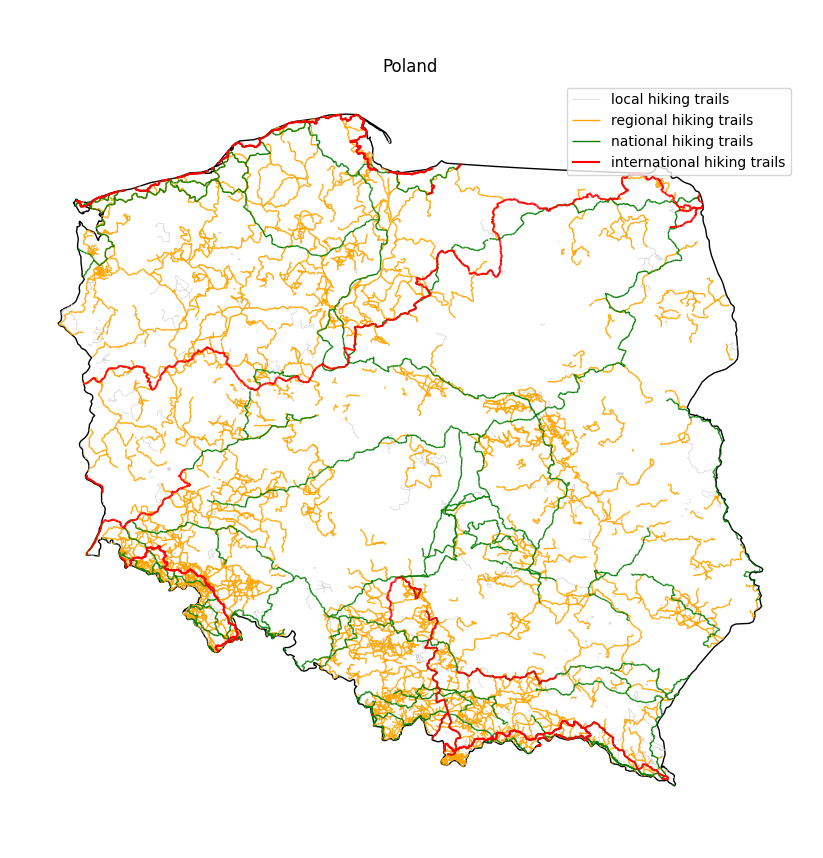
Analysis of the hiking trails in Poland entered in the OSM database.
Notable Hiking Trails in Poland
1. Główny Szlak Beskidzki (Main Beskid Trail)
- Start: Ustroń
- End: Wołosate
- Total Distance: 496 km (308 mi)
- Stages: 27
- Stage Length: 15–25 km (9–16 mi)
- Best Time to Hike: May to October
- Luggage Transport: Available in some sections
- Special Gear: Standard hiking equipment, weatherproof clothing
- Difficulty: Moderate to advanced
- Camping: Limited, but many accommodations along the route
As Poland’s longest marked trail, this route offers a diverse mix of landscapes, from dense forests to rolling hills and traditional villages. Hikers will pass through multiple national parks, enjoying a balance of nature and regional culture.
2. Główny Szlak Sudecki (Main Sudeten Trail)
- Start: Świeradów-Zdrój
- End: Prudnik
- Total Distance: 440 km (273 mi)
- Stages: 22
- Stage Length: 15–25 km (9–16 mi)
- Best Time to Hike: May to October
- Luggage Transport: Available in some sections
- Special Gear: Standard hiking equipment, weatherproof clothing
- Difficulty: Moderate
- Camping: Limited, but many accommodations along the route
Stretching through the Sudeten Mountains, this trail features panoramic mountain views, historic sites, and charming spa towns. Well-marked and accessible, it’s a great choice for those wanting a mix of adventure and comfort.
3. Szlak Orlich Gniazd (Eagle’s Nests Trail)
- Start: Kraków
- End: Częstochowa
- Total Distance: 164 km (102 mi)
- Stages: 7–10
- Stage Length: 15–25 km (9–16 mi)
- Best Time to Hike: April to October
- Luggage Transport: Not available
- Special Gear: Standard hiking equipment
- Difficulty: Moderate
- Camping: Limited, but many accommodations along the route
This scenic trail runs through the Kraków-Częstochowa Upland, connecting medieval castles and ruins perched atop limestone cliffs. A perfect hike for history lovers, blending rich heritage with natural beauty.
4. Szlak Piastowski (Piast Trail)
- Start: Gniezno
- End: Kalisz
- Total Distance: 150 km (93 mi)
- Stages: 6–8
- Stage Length: 15–25 km (9–16 mi)
- Best Time to Hike: April to October
- Luggage Transport: Not available
- Special Gear: Standard hiking equipment
- Difficulty: Easy to moderate
- Camping: Limited, but many accommodations along the route
This trail follows the footsteps of Poland’s first rulers, passing through ancient cities, historical sites, and key landmarks from the country’s early history. It’s an ideal route for those who enjoy cultural exploration alongside hiking.
5. Szlak Zamków Piastowskich (Piast Castles Trail)
- Start: Grodziec
- End: Wleń
- Total Distance: 146 km (91 mi)
- Stages: 7–9
- Stage Length: 15–20 km (9–12 mi)
- Best Time to Hike: April to October
- Luggage Transport: Not available
- Special Gear: Standard hiking equipment
- Difficulty: Moderate
- Camping: Limited, but many accommodations along the route
This trail takes hikers through Lower Silesia’s castle region, where historic Piast dynasty castles are surrounded by forests and rolling hills. A great choice for those looking to combine history with outdoor adventure.
6. Kaszubian Switzerland Trail
- Start: Kartuzy
- End: Kościerzyna
- Total Distance: 140 km (87 mi)
- Stages: 6–8
- Stage Length: 15–25 km (9–16 mi)
- Best Time to Hike: May to September
- Luggage Transport: Not available
- Special Gear: Standard hiking equipment
- Difficulty: Easy to moderate
- Camping: Well-suited, many campsites available
This scenic trail winds through forests, lakes, and rolling hills, passing through traditional Kashubian villages. It’s a great choice for hikers looking for a mix of nature, culture, and relaxation with plenty of camping spots.
7. Szlak Nadmorski (Coastal Trail)
- Start: Świnoujście
- End: Hel
- Total Distance: 370 km (230 mi)
- Stages: 14–18
- Stage Length: 20–25 km (12–16 mi)
- Best Time to Hike: May to September
- Luggage Transport: Not available
- Special Gear: Standard hiking equipment
- Difficulty: Easy to moderate
- Camping: Well-suited, many campsites along the coast
This trail follows the Baltic Sea coast, offering stunning sea views, sandy beaches, and coastal forests. Ideal for those who enjoy a combination of hiking and seaside landscapes.
8. Białowieża Forest Trail
- Start: Białowieża
- End: Białowieża (circular routes)
- Total Distance: 20 km (12 mi) with various route options
- Stages: 1–2
- Stage Length: 10–20 km (6–12 mi)
- Best Time to Hike: April to October
- Luggage Transport: Not needed
- Special Gear: Standard hiking equipment, binoculars
- Difficulty: Easy
- Camping: Limited, but many accommodations in Białowieża
A UNESCO World Heritage Site, Białowieża Forest is home to the last wild European bison. Hikers can explore ancient woodland and rich biodiversity, making it a must-visit for wildlife enthusiasts and nature lovers.
9. Świętokrzyski National Park Trail
- Start: Święta Katarzyna
- End: Nowa Słupia
- Total Distance: 30 km (19 mi)
- Stages: 1–2
- Stage Length: 15–30 km (9–19 mi)
- Best Time to Hike: April to October
- Luggage Transport: Not needed
- Special Gear: Standard hiking equipment
- Difficulty: Easy to moderate
- Camping: Limited, but many accommodations along the route
Known for its sacred mountains and dense forests, this national park offers both cultural and natural attractions, making it accessible for hikers of all levels.
10. Szlak Papieski (Papal Trail)
- Start: Zakopane
- End: Stary Sącz
- Total Distance: 230 km (143 mi)
- Stages: 10–14
- Stage Length: 15–20 km (9–12 mi)
- Best Time to Hike: May to October
- Luggage Transport: Not available
- Special Gear: Standard hiking equipment
- Difficulty: Moderate
- Camping: Limited, but many accommodations along the route
Following the footsteps of Pope John Paul II, this trail runs through the Polish Carpathians, offering a unique mix of spiritual and natural experiences. A great choice for hikers seeking meaningful routes in beautiful landscapes.
Camino de Santiago Routes in Poland
Poland has several Camino de Santiago routes, connecting to the wider European pilgrimage network. These routes allow pilgrims to walk through Poland and join the well-established paths leading to Santiago de Compostela in Spain.
1. Polish Camino (Polski Szlak św. Jakuba)
- Start: Kaunas, Lithuania
- End: Frankfurt (Oder) or Görlitz, Germany
- Total Distance: ~900 km (560 mi) to Murowana Goślina
- Additional Routes:
- Murowana Goślina to Frankfurt (Oder): ~280 km (174 mi)
- Murowana Goślina to Görlitz: ~350 km (217 mi)
This longest Polish Camino route begins in Kaunas, Lithuania, crosses Masuria’s lakes, and reaches Gniezno, Poland’s first capital. From Gniezno, the Greater Poland (Wielkopolska) and Lower Silesia routes continue through Poznań towards Görlitz. Pilgrims can either follow the Zittau Camino to Prague or turn west at Murowana Goślina towards Frankfurt (Oder), where the Brandenburg Camino connects to Berlin.
2. Pomeranian Camino (Szlak św. Jakuba Pomorski)
- Start: Kretinga, Lithuania
- End: Szczecin (Stettin) or Świnoujście
- Total Distance: ~900 km (560 mi) to Wolin
- Additional Routes:
- Wolin to Szczecin: ~99 km (62 mi)
- Wolin to Świnoujście: ~44 km (27 mi)
Following the Baltic Sea coastline, this route begins in Lithuania and crosses Kaliningrad before reaching Gdańsk. From Wolin, pilgrims can either turn south to Szczecin to follow the Via Imperii to Berlin and Leipzig, or head west to Świnoujście, where they can join the Via Baltica towards Rostock and Hamburg.
3. Via Regia
- Start: Kraków
- End: Görlitz, Germany
- Total Distance: ~560 km (348 mi)
This historic “Royal Route” connects Kraków with Wrocław and Görlitz, leading into Germany’s medieval pilgrimage network. The Via Regia continues westward through Leipzig and beyond, forming a key part of the European Camino network.
Unfortunately, there is very little information to be found on these routes in English. There is a German site with more information on Jakobswege-Europa. And if you want to take a look at the European Camino Santiago network, checkout the Spanish interactive site on nco.ign.es.
European Long-Distance Trails in Poland
For long-distance hiking enthusiasts, Poland offers a rich selection of European long-distance hiking trails (E-paths). Five of the twelve official E-paths cross or pass through Poland, providing access to diverse landscapes, historical towns, and natural wonders.
E3 (European Long-Distance Path 3)
- Route in Poland: Crosses from Zittau, Germany, to the Ukrainian border
- Length in Poland: ~900 km (560 mi)
- Main Regions: Sudetes, Beskids, Carpathians
- Best Time to Hike: May to October
The E3 passes through Poland’s most scenic mountain ranges, including the Giant Mountains (Riesengebirge) and Tatra National Park. Along the way, hikers encounter historical cities, picturesque valleys, and cultural landmarks.
E9 (European Long-Distance Path 9)
- Route in Poland: From Świnoujście on the German border along the Baltic Sea coast to Braniewo on the Russian border
- Length in Poland: ~700 km (435 mi)
- Main Regions: Pomerania, West Pomerania, Baltic Coast
- Best Time to Hike: May to September
Following the coastline of the Baltic Sea, the E9 offers breathtaking sea views, sandy beaches, and coastal forests. Highlights along the route include the historic port cities of Gdańsk and Gdynia, as well as secluded dunes and nature reserves.
E11 (European Long-Distance Path 11)
- Route in Poland: From the German border near Guben to the Lithuanian border
- Length in Poland: ~750 km (466 mi)
- Main Regions: Greater Poland, Masuria, Podlasie
- Best Time to Hike: May to October
The E11 traverses Poland’s heartland, passing through charming historical towns, the Masurian Lake District, and the ancient Białowieża Forest. This route is ideal for those who love both cultural heritage and unspoiled nature.
E8 (European Long-Distance Path 8)
- Route in Poland: From the Czech border near Głuchołazy to the Ukrainian border
- Length in Poland: ~800 km (497 mi)
- Main Regions: Upper Silesia, Beskids, Tatra, Carpathians
- Best Time to Hike: May to October
The E8 is one of Poland’s most mountainous E-paths, winding through some of the country’s most beautiful highland areas, including the Beskids and Tatra Mountains. The route features diverse landscapes, mountain passes, and historic settlements.
E7 (European Long-Distance Path 7)
- Route in Poland: From the Czech border near Pielgrzymów to the Slovakian border
- Length in Poland: ~300 km (186 mi)
- Main Regions: Beskids
- Best Time to Hike: May to October
The E7 runs through the gentle, forested Beskid Mountains, an area famous for rolling hills, dense woodlands, and picturesque villages. It is one of the lesser-traveled E-paths in Poland but offers a peaceful hiking experience.
Where to Stay While Hiking in Poland
Poland offers a variety of accommodation options for hikers, especially in popular trekking regions. Whether you prefer hotels, guesthouses, or more rustic stays, you’ll find plenty of choices to suit your hiking adventure.
Hotels, Guesthouses & Rural Stays (Agroturystyka)
- In major hiking areas, you’ll find hotels, guesthouses (pensjonaty), and lodges.
- Many farm stays (Agroturystyka) offer accommodation, often with traditional Polish food and a local experience.
- Some campsites also provide small cabins, which are ideal for hikers without tents.
Mountain Huts (Schronisko) & PTTK Lodges
- Poland’s national parks often have mountain huts (schronisko) or hiking hostels, many of which are run by the Polish Tourist and Sightseeing Society (PTTK).
- Unfortunately, most official websites are only in Polish, and Google Translate can be more amusing than helpful.
- The best way to find availability and book is usually through booking portals like Booking.com or the regional or national park tourism websites.
Camping & Wild Camping Rules
- Poland has many well-equipped campsites, some of which are linked to Agroturystyka farm stays and may offer tent spaces on request.
- Wild camping is generally not allowed, but there are 425 designated forest areas where hikers can camp for up to two nights if they follow Leave No Trace principles.
- Occasionally, camping near mountain huts is allowed, but you should always check with the hut management first.
Tip: If you plan to camp in Poland’s forests, make sure to research the designated areas in advance. The official forestry service has a map of permitted zones, though it’s mostly in Polish.
What Gear Do You Need for Hiking in Poland?
Hiking in Poland generally doesn’t require much more than the classic trio:
✔ Good hiking shoes with a grippy sole
✔ Quick-drying hiking clothing suitable for the season
✔ A comfortable backpack to carry essentials
Additional Gear Based on the Terrain
- Mosquito repellent → Essential when hiking in lake regions (e.g., Masuria) or marshy areas.
- Waterproof clothing → A must-have in the mountains, as the weather can change suddenly.
- Trekking poles → Highly recommended for mountain hikes, as they help with steep ascents and descents.
If you plan on multi-day hikes, you may want to pack extra layers for cooler nights and a power bank to keep your devices charged, as not all mountain huts have reliable electricity.
Replacing or Upgrading Your Hiking Gear in Poland
If you realize on the trail that you’re missing an essential piece of gear or something breaks, you’ll usually find outdoor stores in larger towns and the main tourist hubs.
Where to Buy Outdoor Gear in Poland
- 8a & Skalnik → Poland’s top outdoor specialists, with several physical stores and strong online shops.
- Decathlon & Intersport → Widely available in most cities and great for affordable hiking essentials.
Important:
- While 8a, Skalnik, and Decathlon Poland offer reliable and fast shipping, their websites are only available in Polish.
- Even though 8a also has e.g. a German website, they only ship within Germany.
- If you don’t speak Polish, Google Translate will be your best friend when ordering online.
Shipping & Delivery in Poland
- Fast and reliable services: Poczta Polska (Polish Post), InPost, DPD, and DHL.
- Delivery time within Poland: 1–3 business days.
- Delivery from Central Europe (Germany, Netherlands, Austria, etc.): 3–7 business days.
Where to Pick Up Your Order?
- Parcel lockers (Paczkomaty by InPost) and pick-up points are widely available, often in supermarkets, gas stations, and convenience stores.
- If no pick-up location is nearby, your next hotel or guesthouse will likely accept a package for you—just ask in advance!
Food & Supplies: Where to Stock Up While Hiking in Poland
If you need to refill your food supplies while hiking in Poland, you’ll find plenty of supermarkets, convenience stores, and local markets in towns and villages.
Where to Buy Food?
- Supermarkets: Large chains like Biedronka, Lidl, Carrefour, Tesco, Auchan, and Kaufland are easy to find in bigger towns.
- Small grocery stores (Sklep Spożywczy): In rural areas, local convenience stores or small family-run shops are more common.
- 24/7 Stores: Żabka and Freshmarket are useful, as they are open around the clock, even on Sundays and holidays, in larger towns and tourist hotspots.
- Markets: Farmers’ markets or weekend markets (often on Saturdays) sell fresh produce and local specialties, especially in smaller towns and villages.
Opening Hours:
- Large supermarkets: 6 AM – 10 PM
- Small shops: 7 AM – 9 PM
- Sundays & Holidays: Most stores are closed or have limited hours due to Poland’s Sunday trading ban.
Key Holidays with No Shopping:
Aside from religious holidays like Easter, Pentecost, and Christmas, keep an eye on:
- May 3 – Constitution Day
- August 15 – Assumption of Mary
- November 11 – Independence Day
Where to Get Hot Meals?
If you prefer warm food, Poland offers plenty of options:
- Restaurants, bars, and street food stalls → Easy to find in tourist areas and bigger towns.
- Mountain huts (Schronisko) → Many provide meals, especially in Tatra, Beskid, and Sudeten regions.
- Hotels, guesthouses & agritourism lodges → Often offer half-board if there are no restaurants nearby.
Typical Dining Hours:
- Restaurants: 12 PM – 9/10 PM
- Food stalls & takeaways: 10 AM – 8 PM (hours vary by location)
-
Sundays & Holidays: Many places close outside tourist hubs.
And while you are there: You really should try some Pierogi (stuffed dumplings). And if the weather is really foul, some Bigos (a hearty hunter’s stew) will warm you right back up.
Drinking Water – Staying Hydrated While Hiking in Poland
Tap water in Poland is officially safe to drink according to World Health Organization standards, but many locals still boil their water before consuming it. While modernization efforts are improving water quality in cities and tourist areas, it can still vary, especially in rural regions where old piping systems are still in use.
Before drinking tap water in remote areas, it’s best to ask locals whether it’s safe or stick to bottled water. In larger cities, public drinking fountains are becoming more common, and water from these designated fountains is generally safe.
If you plan to use natural water sources, filtering is highly recommended. In Poland’s remote mountain regions and national parks, you can often find clean water, but always use a filter to be safe. In areas with a history of mining or intensive agriculture, contaminants from the past may still be present, which no standard filter can remove. In these places, relying on tap or bottled water is the better choice.
Quick Travel Info – Getting to and Around Poland
Language: The official language is Polish. In tourist areas, many people speak at least basic English, and in regions near Germany, you might also find German speakers. As always, a friendly smile and a few Polish words will go a long way. If needed, Google Translate or Deepl can help.
Currency: Polish Złoty (PLN) (Autumn 2024: 1 PLN ≈ 0.23 EUR)
Payment Methods: Major credit cards are widely accepted, but cash is still common, especially in rural areas. Contactless and mobile payments are mostly found in cities and tourist hotspots.
Time Zone: Central European Time (CET) – the same as Berlin, Paris, and Rome.
By Air:
- The largest airport is Warsaw Chopin (WAW), with easy train and bus connections to the rest of the country.
- For the Baltic coast, Gdańsk is a better option.
- For southern hiking regions, Kraków, Wrocław, and Katowice are the best entry points.
- Many flights operate from major European cities, including low-cost carriers, especially in high season.
By Train:
- The Berlin-Warsaw Express connects both capitals in a few hours.
- Intercity trains from Berlin, Vienna, and other major cities offer direct routes to Warsaw, Katowice, Wrocław, and Kraków.
- Night trains from Vienna go to Kraków and Warsaw.
By Bus:
- Long-distance buses like FlixBus and Eurolines connect Poland with much of Europe.
Train services are well developed, with PKP Intercity operating long-distance routes. Regional trains connect smaller towns and rural areas.
Bus networks are extensive, combining long-distance and local routes. However, as in many European countries, service frequency is much higher in cities and can be less frequent in rural areas.
Jakojade (website & app) is useful for planning public transport routes, as it covers most transport providers in Poland. However, the site is only in Polish, so some guessing might be needed.
Standard European voltage (230V) – if you use Europlugs, you won’t need an adapter.
Mountain huts may not have power or working sockets, so bringing a power bank is highly recommended to keep your devices charged.
Safety & Emergency Information
General Safety
Poland is a very safe country for travelers, and once you leave the larger tourist areas, the risk of any trouble is minimal. As always, keep an eye on your belongings, as petty theft and mix-ups with other hikers’ gear can occasionally happen. However, this is a general travel rule rather than a specific warning for Poland.
So, use common sense, keep your essentials close, and you should have no problems.
Encounters with Wildlife
Among Poland’s larger wild animals, wild boars are the ones you’re most likely to see, especially in forested areas. If you come across one, stay calm, speak softly, and slowly back away. In most cases, they will run off as soon as they sense you. If they don’t, don’t approach—just find an alternative route.
In the Carpathians and Beskids, wolves and bears are present. While sightings are extremely rare, it’s still a good idea to stop by the local tourist information office for the latest updates on wildlife activity. Most of the time, these animals avoid humans, but in case of an encounter, remain calm, back away slowly, and do not run.
Herding dogs are also common in regions with wolves or bears. These large, usually white dogs are there to protect livestock and may bark or growl if you get too close. Always respect warning signs, and if a dog is guarding a herd, give it space and avoid sudden movements.
Dangerous Plants
Poland doesn’t have many dangerous plants, but some common toxic species include foxglove and lily of the valley. As a general rule, if you don’t know the plant, don’t touch it.
One exception is giant hogweed, an invasive species that is spreading across Poland. This huge plant (up to 3.5m tall, 1.5m wide) with purple blotches on its green stem can cause severe burns and blisters if its sap comes into contact with your skin and is exposed to sunlight. Avoid touching it at all costs. Don’t confuse it with common hogweed, which grows up to 2m tall and is harmless.
What to Do in an Emergency
If you need emergency assistance, dial 112 (the EU-wide emergency number).
For mountain rescue, call 985 or 601 100 300 (GOPR/TOPR).
Medical care is well-developed, particularly in cities and tourist regions, and still decent in rural areas. The mountain rescue teams are highly trained, though helicopter rescues depend on weather conditions. That’s why carrying a good first aid kit and knowing how to use it is essential.
To avoid costly surprises, always carry your EHIC (European Health Insurance Card) if you’re from the EU. However, this card does not cover private clinics, medical evacuation, or additional costs, so a good travel insurance policy is still highly recommended.
Where to find more information?
For comprehensive information on hiking in Poland, the Polish Tourist and Sightseeing Society (PTTK) maintains an extensive network of trails and accommodations. While their official website is primarily in Polish, it offers valuable insights for those willing to navigate it.
For inspiration and detailed guides in English, several travel blogs provide firsthand accounts and tips:
- Thru-Hiking: Provides detailed information on the Main Beskid Trail, Poland’s longest long-distance trail, covering essential aspects for prospective hikers.
- Breaking the Borders: An outdoor blog by Karolina Tuszyńska, focusing on multi-day hiking and long-distance trekking in Poland.
- Bunch of Backpackers: Offers insights into hiking the Tatra Mountains and the Sudeten Mountains, including practical advice and personal experiences.
Additionally, the official Polish tourism website offers general information and inspiration for travelers:
- Poland Travel: The official tourism portal provides a wealth of information on various destinations and activities across Poland.
These resources should equip you with the necessary information to plan and enjoy your hiking adventures in Poland.
Poland offers a fascinating variety of hiking trails, ranging from majestic mountains to idyllic lake landscapes. If you’re eager to explore even more after your adventures here, why not continue your journey?
Germany awaits with diverse routes stretching from the North Sea coast to the Alps, offering endless hiking opportunities. Or venture into neighboring Czechia, where breathtaking rock formations and deep forests invite exploration.
For those who love hiking and want to immerse themselves even further, a well-planned multi-day trek unlocks even greater opportunities to experience nature up close. Take a look at how to prepare for your next long-distance hike—whether in Poland, Germany, or Czechia!
Happy hiking!