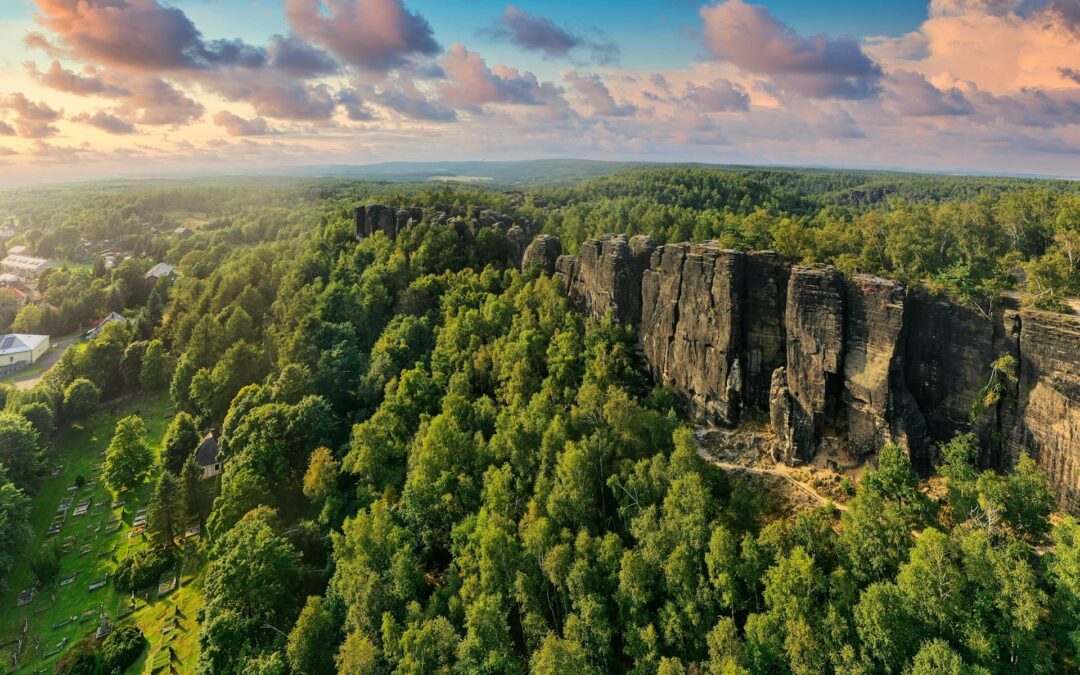
Featured-Photo by Viktor Bezdek on Unsplash
Hiking is extremely popular in the Czech Republic, and for good reason! Discover the breathtaking landscape of Bohemian Switzerland with its famous Pravčická Gate, the majestic peaks of the Giant Mountains, or the enchanting trails of Bohemian Paradise.
Whether you’re a beginner or an experienced hiker, the Czech Republic offers a dense and well-marked network of hiking trails. Get inspired and learn more about the best hiking destinations and practical tips for your hiking holiday in the Czech Republic!
The hiking season in the Czech Republic generally runs from April to October.
In the spring (around April to June), the weather is usually mild, and the landscapes are in full bloom, especially in the Bohemian Switzerland and the Bohemian Paradise.
Due to the continental climate in the Czech Republic, with hotter summers and colder winters than many parts of Western Europe, it is better to escape to higher areas during the summer. The Krkonoše Mountains (Giant Mountains) and Ore Mountains, or the gorges between the rocks of Bohemian Switzerland, offer cooler retreats.
In the autumn (especially September and October), the stunning colours of the leafy forests can be admired in almost all regions of the Czech Republic. Even misty mornings often have their own special charm.
In winter, winter hikes with snowshoes are also popular in the Czech Republic. Groomed winter hiking trails, like those in some Alpine regions, are not as common, and stepping onto the cross-country ski trails should be avoided by walkers. So snowshoes often are the best choice for a nice winter hike. But especially in winter tourist areas you also often find some space next to the ski trails for regular hikers. In the Krkonoše Mountains (Giant Mountains), Bohemian Forest, or Jizerské Hory, you’ll often find good company. Alternatively, you can put on cross-country skis yourself and explore the dozens, if not hundreds, of kilometres of groomed trails.
Hiking Trails in the Czech Republic
Where can you hike in the Czech Republic?
The most beautiful and well-known hiking areas in the Czech Republic are located around the Bohemian Basin, mostly near the borders. From the Bohemian Forest in the southwest and west, along the Ore Mountains and Elbe Sandstone Mountains (Bohemian Switzerland) in the north, to the Krkonoše Mountains (Giant Mountains) and finally the first foothills of the Beskids in the southeast. There are also many smaller mountain ranges in between. The wine regions of Moravia in the south are also perfect for delightful hiking tours.
The Czech Republic has around 43,000 km (about 26,700 miles) of marked hiking trails. All trails are colour-coded, so you just need to follow the colours (mostly red, yellow, blue, or green) on trees, bushes, and stones, and it’s hard to get lost.

Analysis of the hiking trails in the Czech Republic entered in the OSM database.
Typically, the trails are marked as follows:
- Red: Ridge and long-distance trails
- Blue: Other major trails
- Green: Local trails
- Yellow: Official shortcuts and other trails that don’t fit into the above categories
Interesting Hiking Trails in the Czech Republic
The Czech Republic has a fantastic, well-maintained network of hiking trails, but very few long-distance trails. Most trails are only one to two days long, and hikers often create their own favourite routes using mapy.cz.
The most famous long-distance trail for German hikers is the Czech section of the Friendship Trail (EB: Eisenach – Budapest), which follows the European long-distance path E3. This route starts in Bohemian Switzerland and continues through the Jizera Mountains, Krkonoše Mountains (Giant Mountains), and Jeseníky Mountains, before heading into Slovakia’s Little Fatra. Along the way, the trail takes a generous detour through Poland near the Krkonoše Mountains, before returning to the Czech Republic and then into Slovakia.
However, the E3 is not the only European long-distance path that brings you to the Czech Republic. The E10, on its way to Nice, passes directly through the Czech Republic and goes through Prague. The E6 can be hiked along the Bavarian-Czech border, also on the Czech side. The E8 touches the Czech Republic in the south.
For pilgrims, there are also several Camino de Santiago (St. James Ways) passing through the Czech Republic. The most well known leads you from Zittau to Prague. And then on two different routes to Germany. You could choose whether you want to pass through Nuremberg or head straight to Regensburg. There are also two other routes that cross through the Czech Republic further to the south if you wish to see more of the central Czech Republic or more of Moravia and Brno.
The Most Popular Hiking Regions in the Czech Republic
The most popular hiking regions in the Czech Republic are:
Bohemian Switzerland (České Švýcarsko)
- Location: Northwest of the Czech Republic, on the border with Germany
- Marked Trails: approx. 400 km (250 miles)
- Highlights: Sandstone formations, Pravčická brána (Pravčice Gate), gorges
- Best Hiking Season: Spring to Autumn
Bohemian Switzerland is renowned for its spectacular sandstone formations, deep gorges, and impressive rock arches. The highlight of the region is the Pravčická brána (Pravčice Gate), the largest natural sandstone arch in Europe. Hikers can explore the picturesque landscape on well-marked trails and paths. The region offers a unique blend of untouched nature and impressive geological formations, captivating both hikers and photographers.
Krkonoše Mountains (Giant Mountains)
- Location: Northeast of the Czech Republic, on the border with Poland
- Marked Trails: approx. 800 km (500 miles)
- Highlights: Sněžka (Snow Mountain), waterfalls, alpine landscape
- Best Hiking Season: Summer to Autumn
The Krkonoše Mountains are the highest mountain range in the Czech Republic and offer an impressive, almost alpine landscape. Sněžka, the highest peak in the country, is a popular hiking destination. The region is known for its waterfalls, mountain meadows, and dense forests. Hikers can enjoy well-marked trails that offer breathtaking views and a variety of natural attractions. The national park protects a rich flora and fauna and is a paradise for nature lovers.
Bohemian Paradise (Český ráj)
- Location: Northeast of the Czech Republic, between Prague and Liberec
- Marked Trails: approx. 400 km (250 miles)
- Highlights: Rock formations, castles, historical sites
- Best Hiking Season: Spring to Autumn
Bohemian Paradise is known for its dramatic rock formations and castle ruins. The region is a UNESCO Geopark and offers a variety of hiking trails through picturesque landscapes. Notable sights include the Prachov Rocks and Trosky Castle. The area is ideal for hikers who want to explore both the natural beauty and the historical significance of the region.
Bohemian Forest (Šumava) National Park
- Location: Southwest of the Czech Republic, on the border with Germany and Austria
- Marked Trails: approx. 500 km (310 miles)
- Highlights: Moors, clear lakes, untouched nature
- Best Hiking Season: Spring to Autumn
The Bohemian Forest is a vast, forested area known for its clear lakes and moors. The Šumava National Park protects one of the largest contiguous forest landscapes in Central Europe. Hikers can enjoy the tranquility and seclusion of untouched nature. The well-marked trails lead through deep forests, along clear rivers and lakes, offering numerous opportunities for wildlife observation.
Moravian Karst (Moravský kras)
- Location: Southeast of the Czech Republic, northeast of Brno
- Marked Trails: approx. 200 km (125 miles)
- Highlights: Caves, gorges, Macocha Gorge
- Best Hiking Season: Spring to Autumn
The Moravian Karst is known for its impressive caves and gorges. The Macocha Gorge, nearly 140 meters (460 feet) deep, is one of the largest gorges in Central Europe. Hikers can explore numerous caves, including the Punkva Caves with their underground lakes. The region offers a fascinating mix of geological wonders and natural beauty, attracting both adventurers and nature lovers.
Where Can You Sleep While Hiking?
In the Czech Republic, there are plenty of pensions, hotels, and hostels available for tired hikers. In the Krkonoše Mountains (Giant Mountains), the mountain huts are usually called “bouda” and are often larger than those you might be familiar with in the Alps.
The Czech Republic is also one of the countries where you can occasionally stay in old castles or manor houses at a reasonable price. Many of these from the Austro-Hungarian era are scattered across the country and have often been lovingly restored. Most hostels are simple but clean, practical, and quite affordable.
Another charming option are “chalupas,” traditional wooden houses converted into guesthouses, often located in picturesque settings, waiting to welcome guests.
If you prefer to camp, you will find plenty of campsites throughout the country, especially near popular tourist areas. Wild camping is officially forbidden and can be heavily fined. However, if you find a spot outside all nature reserves and protected zones, and you do not disturb anyone or leave any traces, you might get away with just a warning.
What Equipment is Needed?
For the most part, you don’t need anything different for hiking in the Czech Republic than you would for any mid-mountain hike: good hiking boots with grippy soles, sturdy hiking clothing, and a well-fitting backpack. Additionally, a simple rain cover is essential.
If you’re heading into the higher mountains, it’s always good to pack an extra fleece and possibly some trekking poles, especially if the descents are longer than expected. A better rain cover is also advisable, as it may be a bit further to the next shelter or hut. When it rains, it can rain for a longer period, and thunderstorms are also quite common in the summer.
In the Czech Republic, hikers are required to wear reflective clothing, bands, or safety vests on roads outside of towns when it is dark or foggy. So, if you’re hiking in autumn or planning particularly long day hikes, it’s better to carry some reflective bands or a safety vest.
In winter, you should have the usual winter equipment, including crampons, and of course, the aforementioned reflectors.
How to Replace or Supplement Equipment
If you find that you are missing a piece of equipment or something has broken during your hike, you are well-covered in the Czech Republic. In larger cities like Prague, Brno, Ostrava, or Pilsen, you will usually find at least one store from the major outdoor suppliers such as Sportisimo, Decathlon, HUDYsport, or Rock Point. In popular tourist destinations like Špindlerův Mlýn, there are also usually smaller retailers with a good selection of useful items.
If you can’t find what you need in stores, the internet is your next option. Alza.cz is a local online retailer with an English version of their website and fast delivery times. Remember to check the prices carefully, as they are listed in Czech Crowns, not in Euros. Sportisimo is a specialised sports goods retailer but their website is only available in Czech.
Parcel lockers and package shops are available throughout the country, making it easy to have a package delivered to a convenient location. Within the Czech Republic, most parcels take 1-2 business days to arrive, and the Czech Post, PPL, and DHL are considered reliable.
If you need to order something from other central european countries, expect shipping times to be around 3-5 business days.
Provisions: How to Stock Up on Food While Hiking
In the Czech Republic, you’re most likely to stock up on supplies at supermarkets. In every larger town, you’ll find branches of major chains like Tesco, Albert, or Kaufland. The larger stores are usually open seven days a week, typically from 7 am to 9 pm, and sometimes even until 10 pm. On Sundays, they might have shorter hours.
In smaller towns, you’ll find smaller grocery stores, branches of supermarkets, or speciality shops that are usually open from Monday to Friday, 8 am to 6 pm, and on Saturday mornings. Some of these shops might take a lunch break from 12 pm to 2 pm.
On major national holidays (e.g., Victory Day on May 8th, State Holiday on September 28th, or Independence Day on October 28th) and common holidays (New Year’s Day, Easter Monday, Christmas), many shops are closed or have shorter opening hours.
You can still find weekly markets in many villages and small towns, usually on Saturday mornings. Here you’ll find fresh produce and often the best regional specialities.
For hot meals along the way, you can visit boudy (mountain huts) and pensions. There are also restaurants and inns along the trails. In the summer, you’ll frequently come across beer gardens near towns and tourist areas where you can refresh yourself. They usually open at 11 am and often stay open until 10 pm. The most common rest day is Monday and holidays, but in popular tourist areas, you will usually find at least one open restaurant.
Don’t forget to try the local cuisine. The Czech Republic without dumplings is like Italy without pasta – unthinkable! Also, Czech beer and Moravian wine are definitely worth a try. And if you prefer something non-alcoholic, try Kofola! This Czech version of cola tastes better to some people than the American version ever could.
Drinking – Tips for Your Water Supply While Hiking
The best way to stock up on drinking water in the Czech Republic is at hostels. You can also fill up in a restaurant, a baude (mountain hut), or a café along the way (of course, while you are a guest there).
In some places, you might find public water fountains, but you should filter the water unless it is explicitly marked as drinking water.
Water from small streams away from heavily farmed or industrial areas is usually drinkable after filtering. However, you should be mindful of the local history of the area you are hiking in. If there has been old mining activity, farming, or military training grounds, it’s better to plan from one baude to another or from hostel to hostel rather than relying on surface water, if possible.
You should generally avoid water from larger rivers or lakes, or from streams that have passed through a town.
Quick Info for Travelling
Language: Czech
Communication: Primarily Czech, and most people also understand Slovak since the languages are very similar. In the tourism sector, you will almost always find people who speak either English, German, or both. In case of difficulties, Google Translate or the Deepl app can help.
Currency: Czech Koruna (CZK) (In 2024, the exchange rate was usually around 1 EUR = 25 CZK).
Payment Methods: Primarily credit cards (Visa/Mastercard). Cash is still widely used, especially in rural areas and smaller shops, but credit cards are almost always accepted. Newer payment methods are spreading mainly in big cities but are slowly becoming available in rural areas as well.
Time Zone: Same time zone as the rest of Central Europe (Paris/Berlin/Rome).
By Plane
The most common destination is Prague, but there are also flights to Brno and Ostrava.
By Train
If you’re not in a rush, the Czech Republic is very accessible by train. Eurocity trains cross the country daily from various directions (Germany, Slowakia, Austria, Hungary,…), and you can transfer to smaller local train lines at different major stations. This way, you can comfortably get close to your hiking area by train and take a bus for the remainder of the journey. The trains are rarely modern, but they are almost always functional and, unless they’ve been travelling for an exceptionally long time, they are quite often on time.
By Bus
Various European bus lines (Flixbus, Eurolines, etc.) can also take you to the Czech Republic if you prefer travelling by bus.
Public transport in the Czech Republic is well-developed. The railway network is quite dense and in good condition. Local buses and long-distance buses can take you to almost every corner of the country. Although the vehicles are often a bit older, they are generally well-maintained and in good condition.
Buses and trains in the Czech Republic are generally considered reliable and quite affordable. You can plan your trip and buy tickets on idos.cz.
For buses and trams, you usually need a ticket before boarding. However, in most trains, you can buy a ticket from the conductor if you didn’t manage to get one before departure.
Electricity in the Czech Republic is supplied at 230V. Typically, you won’t need a travel adapter if you are coming from Germany, Austria, or most other European countries that use the same plug types (Type C and Type E/F).
Visitors from Ireland, the UK, Switzerland, Malta, Cyprus will need one though. And visitors from Italy might wish to check twice, if you need an adapter, depending on the plug you use.
Safety & Emergencies
General Safety
Overall, the Czech Republic is a very safe country for hikers. In rural areas, the crime rate is very low. You just need to take the usual precautions against pickpockets in popular tourist spots and avoid leaving your gear unattended in larger hostels.
If you are travelling by car, never leave any valuable items visible in the car. Think carefully about bringing a high-end car to the Czech Republic unless you can park it in a secure, monitored parking area. The issue is not so much the Czech locals, but rather that the routes to illegal markets further east and southeast are shorter from the Czech Republic than from any of the countries further west and north. Unfortunately, this still makes a noticeable difference.
Animals & Plants
In general, there are very few animals to be afraid of in the Czech Republic. While there are bears and wolves in the Beskids and Carpathians, they are extremely rare, and encountering one would almost be a stroke of luck. In the unlikely event of an encounter, stay calm, make yourself known by speaking quietly, and slowly back away. Never trigger their hunting instincts by running away, but also do not provoke them by shouting, throwing things, or waving your arms. Do not take photos until you are far enough away that you can barely see the animal with a zoom lens.
When hiking in the Beskids or Carpathians, try to check with the local tourism office, if there are any known current problems and best practices for the area regarding those animals. Dangerous situations are so rare that they tend to make at least regional, if not national news, so they should be well informed if there actually is anything to know.
The most dangerous animals you might actually encounter are wild boars with piglets. They are mostly active at dusk and should not be underestimated. If you come across them, try to scare them away with noise, but retreat if that doesn’t work.
In some rural areas and nature parks, herd protection dogs are now in use. Usually, there are local posters or other information about where they are working and how to behave. The main rules are to stay calm, avoid the herd if possible, and do not argue with the dogs about your right of way. If one of these usually white giants and its friends are having a bad day and won’t let you pass, it’s best to find another route. Most of the time, they are unproblematic and just a bit grumpy from a distance.
For plants, the usual rule applies: do not touch anything you cannot confidently identify as harmless. The giant hogweed is growing into a particular problem, as it is spreading in the Czech Republic as well (it’s an umbrella-shaped plant, up to 3.5m tall and 1.5m wide, with purple spots on the green stem). Keep a greater distance from it than from a stinging nettle, as its sap can cause burns and blisters on your skin when exposed to sunlight, which may require medical treatment. The native common hogweed looks similar but only grows to about 2m tall and is harmless.
Accidents & Emergencies
If you need help despite all your careful planning and caution, the European emergency number 112 usually applies. Specifically in the mountains, there is also the mountain rescue number 1210. The emergency services and mountain rescue teams are well-equipped and experienced, and the medical care is generally good.
You should of course carry your EHIC card and, if possible, also have travel health insurance for things not covered by the EHIC, such as repatriation or specialised treatments.
Where Can You Find More Information About Hiking?
On www.czechtourism.com, the Czech Tourist Information website, you can find almost all the information you need for a holiday in the Czech Republic. Such comprehensive and nearly complete resources are rare in Europe.
If you want to take a direct look at hiking maps, you can find them on en.mapy.cz.
And if you want to get into the mood for your trip to the Czech Republic, you can find a portal with lots of information and quite current news on www.expats.cz.
To sum up, the Czech Republic is a fantastic hiking destination, offering everything from breathtaking scenery to cultural highlights. Regardless of your hiking experience, you’ll find routes that suit your needs.
If you’re eager to continue your hiking adventures, why not explore the neighbouring countries? Germany offers an array of scenic trails, Austria boasts impressive Alpine routes, Poland provides untouched natural beauty, and Slovakia has majestic mountains waiting to be discovered. Check out our articles on these destinations for more tips and inspiration.
Happy hiking!