
The British are among the most hiking-enthusiastic nations in Europe. England and Wales are crisscrossed with an extensive network of public footpaths and long-distance trails, while Scotland takes it a step further with its “Right to Roam” laws. As long as you follow the guidelines, you’re free to explore the Highlands and remote landscapes at your own pace.
That said, Scotland also boasts some incredible long-distance hiking trails, offering a structured way to experience its breathtaking wilderness. Let’s dive into everything you need to know for your next hiking adventure in the UK!
The best time to go hiking in the UK is generally between Easter and October. The further north you go, the later spring arrives. If you’re heading to Scotland, it’s best to wait until May, while the Munros (Scotland’s highest mountains) follow similar seasonal rules to high-altitude hiking in the Alps—best from mid-June to late September, after which winter conditions can return.
In the southern coastal regions, particularly the southeast, winters are often mild enough for hiking. However, the damp and grey weather may not always offer the most enjoyable experience—it’s up to you whether you find charm in the misty British landscapes.
Typically, UK weather is ideal for hiking, with late spring and summer often dry enough and pleasantly mild, rarely exceeding 30°C (86°F). Frequent light showers and occasional longer periods of rain keep the countryside beautifully green.
In western Scotland, however, weather forecasts can be unreliable due to rapid changes. The saying “If you don’t like the weather, just wait five minutes” exists for a reason. If you’re prepared for all conditions, you might experience breathtaking light effects between rain clouds that make a sunny day seem dull in comparison.
In recent years, the UK has also seen extreme heatwaves and droughts, during which it’s best to avoid long hikes, just as you would in Southern Europe. Likewise, after heavy rainfall and flooding, choosing an alternative hiking destination is often the safest bet. Fortunately, Britain offers a vast variety of landscapes, each with its own unique beauty.
Hiking Trails in the UK
How Many Hiking Trails Are There in the UK?
The UK has a dense network of hiking trails, particularly in England and Wales, where an extensive system of public footpaths and long-distance trails covers the countryside. Scotland, on the other hand, has fewer officially designated trails due to its “Right to Roam” laws, which allow for more flexible access to the outdoors without the need for marked routes.
The most famous and well-maintained trails in the UK are the 16 National Trails, plus the upcoming King Charles III England Coast Path, which is set to become the longest managed coastal walking route in the world. In March 2024, the National Trails network covered approximately 5,800 km (3,600 miles).
Beyond these official trails, the OSM (OpenStreetMap) database lists around 30,000 km (18,600 miles) of additional hiking paths across the country. So, if you’re looking for variety, there’s no shortage of walking routes to explore in the UK!
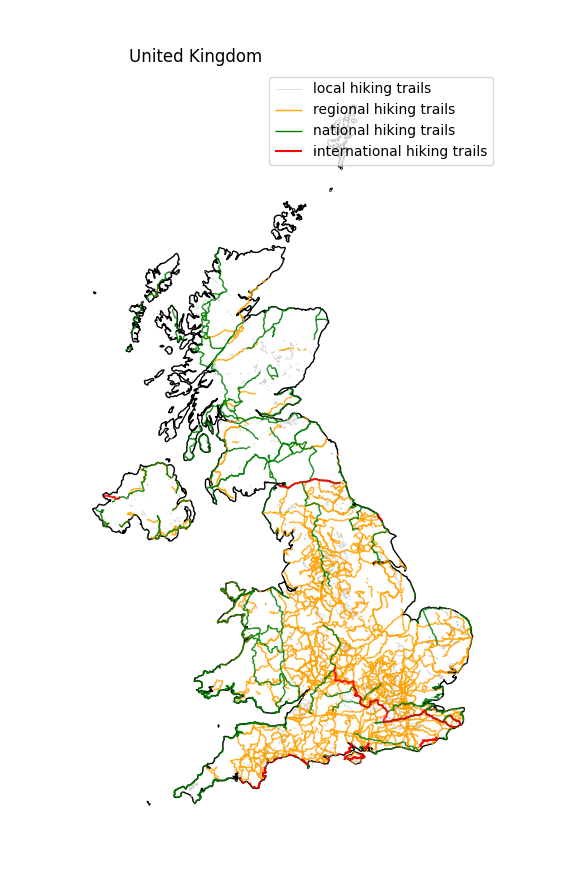
Analysis of the hiking trails in the UK entered in the OSM database.
The Most Popular Hiking Trails in the UK
West Highland Way
- Start: Milngavie (near Glasgow)
- End: Fort William (Scottish Highlands)
- Distance: 154 km (96 miles)
- Stages: Typically 7–8 days
- Average Stage Length: 19–22 km (12–14 miles)
- Baggage Transfer: Available through multiple services (e.g. AMS Scotland, Travel Lite, Baggage Freedom)
- Official Trail Website: www.westhighlandway.org
- Camping: Designated campsites available; wild camping permitted with restrictions
- Challenges: Some long, exposed sections with unpredictable weather; midges in summer
The West Highland Way is one of the world’s most famous long-distance trails, offering a spectacular transition from Scotland’s Lowlands to the rugged Highlands. Passing through Loch Lomond & The Trossachs National Park, the route takes you through forests, moors, remote valleys, and beneath towering peaks, culminating in Fort William near Ben Nevis, the UK’s highest mountain.
Despite its wild beauty, the trail is well-developed, making it a great choice for beginners and seasoned hikers alike. Regular accommodation options, baggage transfer services, and well-marked paths make planning easy. However, its popularity means that off-season hiking (spring/autumn) is recommended for a quieter experience.
Wales Coast Path
- Start: Chester, England
- End: Chepstow, Wales
- Distance: 1,400 km (870 miles)
- Stages: Typically 50–60 days for the full route
- Average Stage Length: 20–30 km (12–19 miles), but flexible
- Baggage Transfer: Available in some areas (list on the paths main page)
- Official Trail Website: www.walescoastpath.gov.uk
- Camping: Campsites available along the route; wild camping is generally not legal in Wales but sometimes tolerated with landowner permission
- Challenges: Exposure to coastal weather, some remote sections with limited facilities
The Wales Coast Path is a unique and spectacular long-distance trail that allows hikers to walk the entire coastline of Wales. Stretching from Chester in the north to Chepstow in the south, it connects a diverse mix of landscapes, including rugged cliffs, sandy beaches, salt marshes, and historic seaside towns. It was the first country in the world to establish a continuous coastal path around its entire shoreline.
One of the greatest features of this trail is its flexibility. While the full 1,400 km (870 miles) route takes around two months, many hikers choose to walk shorter sections, focusing on the dramatic Pembrokeshire coastline, the scenic Gower Peninsula, or the heritage-rich North Wales coastline. With excellent public transport links and accommodation options, the Wales Coast Path is perfect for both thru-hikers and day-trippers alike.
South West Coast Path
- Start: Minehead, Somerset
- End: Poole, Dorset
- Distance: 1,014 km (630 miles)
- Stages: Typically 45–52 days
- Average Stage Length: 20–25 km (12–16 miles)
- Baggage Transfer: luggagetransfers.co.uk
- Official Trail Website: www.southwestcoastpath.org.uk
- Camping: Official campsites available; wild camping not legally permitted but sometimes tolerated
- Challenges: Frequent ascents and descents, exposed coastal conditions
The South West Coast Path is Britain’s longest National Trail, hugging the dramatic coastline of Cornwall, Devon, and Dorset. Featuring steep cliffs, golden beaches, fishing villages, and historic sites, the route is renowned for its breathtaking scenery and constant elevation changes, making it one of the toughest coastal trails in Europe.
Though challenging, it’s also incredibly rewarding. You can hike it in sections, experience some of the UK’s best seaside towns, and enjoy fresh seafood along the way. It’s an ideal route for coastal lovers seeking both a challenge and a picturesque landscape.
Cotswold Way
- Start: Chipping Campden
- End: Bath
- Distance: 164 km (102 miles)
- Stages: Typically 7–10 days
- Average Stage Length: 16–22 km (10–14 miles)
- Baggage Transfer: www.sherpavan.com (“Cotswolds Way South” – so only if you walk north to south)
- Official Trail Website: www.nationaltrail.co.uk/
- Camping: Some campsites available, but limited
- Challenges: Moderate hills, some remote sections with few services
The Cotswold Way is one of England’s most scenic long-distance trails, winding through the idyllic villages and rolling hills of the Cotswolds. With its honey-coloured stone cottages, ancient woodlands, and historic sites, it’s perfect for hikers who enjoy a blend of natural beauty and cultural heritage.
Unlike the rugged trails of Scotland or Wales, this route is gentle and picturesque, making it ideal for those who prefer relaxed walking with plenty of opportunities to explore charming English towns and historical landmarks.
Pennine Way
- Start: Edale, Derbyshire (Peak District)
- End: Kirk Yetholm, Scottish Borders
- Distance: 429 km (267 miles)
- Stages: Typically 16–21 days
- Average Stage Length: 20–25 km (12–16 miles)
- Baggage Transfer: Available (www.sherpavan.com)
- Official Trail Website: www.nationaltrail.co.uk/
- Camping: Designated campsites available; wild camping possible in remote areas
- Challenges: Physically demanding, boggy sections, remote areas
The Pennine Way is England’s oldest and most legendary National Trail, running through the rugged backbone of the country, from the Peak District through the Yorkshire Dales and North Pennines before reaching the Scottish border. Known for its open moorlands, steep ascents, and challenging terrain, it’s one of the UK’s most demanding but rewarding trails.
This is a hike for those seeking isolation, dramatic landscapes, and a sense of achievement. With its wild, untamed scenery and historical significance, the Pennine Way remains a rite of passage for serious long-distance walkers.
King Charles III England Coast Path (Upcoming)
- Start & End: Full loop around England’s coastline
- Distance: Estimated 4,345 km (2,700 miles)
- Stages: TBD, but flexible for section hikes
- Average Stage Length: N/A (varies widely)
- Baggage Transfer: Not yet standard, but likely available in sections
- Official Trail Website: www.nationaltrail.co.uk
- Camping: Limited; wild camping not generally permitted
- Challenges: Unfinished in some areas; logistical planning required
When complete, the King Charles III England Coast Path will be the world’s longest managed coastal walking route, circling England’s entire coastline. It will incorporate many existing coastal paths and offer hikers the unique opportunity to walk the length of England’s shores, from dramatic cliffs to sandy beaches.
Though still under development, sections of the path are already walkable. If you want to be among the first to experience a historic hiking route in the making, this is one to watch!
Beyond Long-Distance Hikes
The UK is not just for thru-hikers—it’s also perfect for station-based hiking holidays. Some of the best areas for day hikes and circular routes include:
- Lake District – Dramatic fells, glacial lakes, and classic summit hikes.
- Scottish Highlands – Iconic peaks, deep valleys, and remote wilderness.
- Wales – The Brecon Beacons, Snowdonia, and the Pembrokeshire Coast offer a mix of mountains and rugged shorelines.
Whether you’re looking for a multi-week epic journey or day hikes from a scenic base, the UK has something for every hiker.
Scotland’s Right to Roam & Outdoor Access Code
One of the unique aspects of hiking in Scotland is its Right to Roam, which allows hikers, cyclists, and campers to access most land freely and responsibly. Unlike England and Wales, where public footpaths define legal access, Scotland’s Land Reform (Scotland) Act 2003 gives everyone the right to explore most open land, including hills, forests, and even privately owned estates—as long as they follow the Scottish Outdoor Access Code.
Key Rules from the Scottish Outdoor Access Code
To ensure Scotland’s landscapes remain accessible and protected, you must follow these key principles:
1️⃣ Respect the Environment
- Leave no trace – Take all litter with you.
- Do not disturb wildlife – Be mindful of nesting birds and fragile habitats.
- Close gates behind you unless signs indicate otherwise.
- Avoid damaging crops – Stick to field edges or follow existing paths.
2️⃣ Respect Other People & Landowners
- Stay away from homes and private gardens – Right to Roam does not include entering personal property.
- Follow local signage – Some areas may have seasonal restrictions (e.g., lambing season).
- Avoid disturbing farm animals – Keep a safe distance from livestock.
3️⃣ Wild Camping – Allowed but with Rules
- Wild camping is legal in most unenclosed land but should be lightweight, low-impact, and short-term.
- Stay away from buildings, roads, and enclosed farmland.
- Camp for no more than 2-3 nights in one spot.
- Use a stove instead of open fires, especially in dry conditions.
- Follow “leave no trace” principles – take all waste with you, including toilet waste if no facilities are available.
🔗 More about Scotland’s Outdoor Access Code
Where Does the Right to Roam NOT Apply?
While access rights are generous, there are some exclusions:
🚫 Private gardens & land around homes
🚫 School grounds & sports fields when in use
🚫 Military, industrial, and railway areas
🚫 Some nature reserves with seasonal wildlife protection
Hiking Scotland Responsibly
Scotland’s Right to Roam is a privilege, not a guarantee—by following the Outdoor Access Code, hikers ensure that future generations can continue enjoying the freedom of the Scottish wilderness.
For more details, visit:
Where to Sleep While Hiking in the UK
Hiking in the UK offers a wide range of accommodation options, especially along the long-distance trails. Whether you prefer the comfort of B&Bs, the affordability of hostels, or the freedom of camping, you’ll find plenty of choices.
Bed & Breakfasts (B&Bs) and Hotels
- The UK has countless B&Bs, many of which cater to hikers—especially along National Trails and in rural areas.
- Prices range from budget-friendly to high-end, depending on location.
- Hotels are widely available in towns and cities along hiking routes.
🔗 Find B&Bs & hotels: www.booking.com, www.visitbritain.com
Hostels & Budget Accommodation
- YHA (Youth Hostels Association) operates hostels across England & Wales.
- SYHA/Hostelling Scotland provides budget stays in Scotland, often in scenic locations.
- Many independent hostels cater to hikers and outdoor enthusiasts.
Camping & Wild Camping Rules
Scotland: A Camper’s Paradise
- Wild camping is legal under the Scottish Outdoor Access Code, allowing you to camp almost anywhere on unenclosed land.
- Follow the “leave no trace” principles and avoid protected areas where camping is restricted.
- Many areas near popular hiking trails also have affordable campsites.
England & Wales: Mostly Campsites
- Wild camping is illegal in England and Wales unless you have landowner permission.
- In remote areas, wild camping is sometimes tolerated, but if asked to leave, you must do so without argument.
- The Lake District National Park has some informal wild camping spots, but it is not officially permitted.
🔗 Find official campsites: www.pitchup.com, www.campingandcaravanningclub.co.uk
Whether you prefer the freedom of wild camping in Scotland, the cozy charm of B&Bs, or the budget-friendly options of hostels and campsites, the UK has something for every type of hiker.
What Gear Do You Need for Hiking in the UK?
Hiking in the UK requires solid, weatherproof gear, as conditions can change rapidly—especially in Scotland and Wales. Here’s what you should pack to stay comfortable and prepared.
Essential Gear
✔ Hiking Boots or Shoes – Sturdy footwear with good grip is essential for muddy paths, rocky trails, and coastal routes. Waterproofing is highly recommended.
✔ Weather-Resistant Clothing – Quick-drying, breathable, and midge-proof materials work best.
✔ Backpack – A comfortable daypack with rain cover to protect your gear.
Weather Protection: Rain & Wind Are Your Main Enemies
- High-quality waterproofs (jacket & trousers) – Expect frequent rain, especially in Scotland and Wales.
- Backpack rain cover – Keeps your gear dry even in heavy showers.
- Windproof layers – The UK’s exposed trails, especially coastal and mountain routes, can be very windy.
Midge & Bug Protection (Scotland & Wales in Summer)
- Bug-proof clothing – Midges bite through thin fabrics, so wear tight-weave, long-sleeved shirts and trousers.
- Head net – A must-have in midge season (June–September), especially in the Scottish Highlands.
- Midge repellent – Buy it locally. UK midges ignore most European insect repellents—use Smidge or Avon Skin So Soft.
Sun Protection (Yes, Even in the UK!)
- Sunscreen – The UK’s sun may not be as intense as in Southern Europe, but long exposure on open trails can still cause sunburn.
- Hat & Sunglasses – A wide-brimmed hat or waterproof cap can work for both rain and sun protection.
- Lip balm with SPF – Wind and sun can dry out your lips quickly.
By packing proper waterproofs, wind protection, and midge repellent, you’ll be well-equipped for the unpredictable but stunning British hiking conditions.
How to Replace or Supplement Gear While Hiking in the UK
If you lose or break a piece of gear while hiking in the UK, you’ll usually find outdoor retailers in larger towns along National Trails and in tourist hubs like the Lake District, Snowdonia, or the Scottish Highlands. While smaller stores may have limited stock, the UK is home to several excellent outdoor brands, so you can often find high-quality replacements or even good deals.
Where to Buy Outdoor Gear in the UK
Physical Stores in Hiking Regions
Many well-known outdoor retailers have stores in major hiking destinations, including:
- Cotswolds Outdoor – Nationwide chain with high-end hiking gear
- Go Outdoors – Large outdoor retailer with locations across the UK
- Blacks – Good for general hiking & camping gear
- Tiso – Scottish outdoor specialist, ideal for Highlands hikes
- Ellis Brigham – Focuses on mountaineering & technical gear
If you’re near a major city or popular hiking area, check Google Maps for smaller independent outdoor shops, as they sometimes have specialist or local gear.
Ordering Online – Quick UK-Based Retailers
If you can’t find what you need in local stores, ordering online is often the best option. UK-based outdoor retailers offer fast delivery (typically 1–2 days) within the UK, making them a reliable choice.
- Trekitt – High-quality gear, often fast shipping
- Alpkit – UK-based, good for lightweight hiking gear
- Decathlon UK – Budget-friendly, good for basic replacements
Amazon UK can be an option, but always check delivery times, as some items may ship from abroad and take longer than expected.
Where to Have Your Order Delivered?
- Your next accommodation – Always ask in advance if they accept parcels.
- Parcel lockers & collection points – Available throughout the UK.
- Outdoor store click & collect – Many retailers allow you to order online & pick up in-store, so if one of their stores is along your route, that too is an option.
Food & Meal Options While Hiking in the UK
Staying well-fed on the trail is essential, and in the UK, your best options for resupplying food depend on whether you’re hiking through populated areas, remote countryside, or carrying a tent for wild camping.
Buying Food Along the Trail
- Small supermarkets can be found in larger towns along hiking routes, stocking basics like bread, cheese, fruit, snacks, and ready-to-eat meals.
- Opening hours are usually Monday to Saturday, 09:00–17:00.
- Sundays & bank holidays: Many shops are closed or have reduced hours. Only a few small supermarkets or convenience stores in fuel stations operate 7 days a week.
- Google Maps is generally reliable for checking store locations and opening times.
Pubs, Cafés & Tea Rooms
- In smaller villages, you’ll often find pubs or tea rooms, where you can grab a hot meal or a classic British tea break.
- Breakfast service usually runs from 07:00–10:30 in B&Bs and some cafés.
- Lunch is typically served between 12:00–14:30.
- Dinner in pubs and restaurants is commonly available from 18:00–21:00—later dining (after 21:00) is rare outside major cities.
- In rural areas, Monday is often a pub/restaurant rest day, so check opening times in advance.
Packed Lunches & Meals in Accommodations
- If your route doesn’t pass through villages, ask B&Bs, hostels, or hotels if they offer packed lunches.
- Many remote hostels and lodges provide options for breakfast, dinner, and a lunch pack for the next day.
If your accommodation offers porridge or a full English/Scottish breakfast, take advantage of it!
- Porridge (oatmeal) is an excellent energy source for long hikes.
- Full English/Scottish Breakfast is hearty and filling – although it may feel heavy at first, it often keeps hikers going well past midday without needing a big lunch.
Food Planning for Wild Camping & Remote Areas
If you’re camping and self-sufficient, you’ll need to plan carefully:
- Some trails pass through areas where no shops exist for days.
- Rural villages may no longer have a grocery store, so check availability in advance.
- Dry food and dehydrated meals are a good option for lightweight cooking.
- Camping stoves are essential if you plan to cook, as open fires are generally not permitted in most areas.
Drinking Water: Staying Hydrated on the Trail in the UK
In general, tap water in the UK is safe to drink, but there are a few things to keep in mind when refilling your bottles, especially in rural areas.
Tap Water – Generally Safe, but Check the Source
✔ Mains tap water is safe to drink across the UK.
✔ In older buildings (especially in remote areas or historic accommodations), plumbing systems may still use outdated pipes. If water has been sitting in old pipes for hours, let it run for a while before drinking.
✔ Public refill points can sometimes be found along major trails, but availability varies—always check in advance.
Surface Water – Only for Remote Scotland & Unpolluted Streams
🚫 Avoid drinking from lakes, rivers, or standing water, even in national parks—water contamination from agriculture, livestock, or old mining areas is common.
✔ Scottish Highlands, Wales, and remote areas of northern England:
- Small, fast-flowing mountain streams that originate high up and away from farmland are generally safe—but always filter or purify before drinking.
- Do not drink untreated water in agricultural regions (e.g., Yorkshire Dales, South Downs) due to fertilizers and livestock runoff.
Best Practices for Water Safety
- Carry enough water for each section of your hike—refill at villages, hostels, or known refill points.
- If using natural water sources, use a water filter (e.g., Sawyer, Katadyn) to remove bacteria and debris.
- Avoid untreated water in farming regions or old mining areas, as it may contain chemical contaminants that filters cannot remove.
- Check refill options before multi-day hikes—some routes, like parts of the South West Coast Path, have few reliable water sources.
Quick Travel Info for Hiking in the UK
- Language: English
- Communication: Standard English is widely understood, but regional accents and dialects (especially in Scotland, Wales, and Northern England) can be challenging at first. Foreign language skills are not common, so Google Translate or DeepL can be useful in remote areas.
- Currency: British Pound (£, GBP)
- Payment Methods: Credit/debit cards are widely accepted. Contactless payment (Apple Pay, Google Pay) is common, and cash is rarely needed, except in very small villages.
- Time Zone: GMT (UTC+0) / BST (UTC+1 in summer)
- 1 hour behind Central European Time (CET) (e.g., if it’s 12:00 in Berlin, it’s 11:00 in London).
🚨 Important! The UK is not part of the EU or Schengen Area. A passport is required for entry—ID cards are not accepted for most travelers.
By Air
Most international arrivals land in London, but there are many regional airports with good connections:
✈ Scotland – Glasgow (GLA), Edinburgh (EDI)
✈ Wales – Cardiff (CWL), Bristol (BRS)
✈ Northern England – Manchester (MAN), Newcastle (NCL)
By Train
🚄 The Eurostar connects mainland Europe to the UK via the Channel Tunnel.
- The best route is to Brussels or Paris, then take the Eurostar to London (www.eurostar.com).
By Bus & Ferry
🚌 Long-distance buses (FlixBus, National Express, Megabus) travel through the Eurotunnel or via ferry crossings from Belgium, the Netherlands, or France.
⛴ Ferries operate between the UK and Ireland, France, the Netherlands, and Spain. Major providers:
Trains
🚆 The UK’s rail network is infamous for delays, strikes, and high prices, but it does connect most major hiking areas.
- Advance tickets are often cheaper (www.nationalrail.co.uk).
- Scenic train routes include the West Highland Line (to Fort William & Mallaig) and the Settle-Carlisle Railway.
Buses & Coaches
🚌 Intercity buses (coaches) and local bus networks are often cheaper and more reliable than trains.
- National Express – Covers long distances.
- Megabus – Budget option for city-to-city travel.
- Local buses reach smaller towns and hiking start points—but check schedules in advance, as some routes are infrequent.
🔌 The UK does not use the standard European plug (Type C). Instead, it uses Type G sockets (three rectangular prongs, 230V, 50Hz).
✔ Bring a UK adapter for charging your devices.
⚡ Sockets often have switches – make sure to turn them on when plugging in!
Power Supply for Multi-Day Hikes
If you’re camping or hiking in remote areas (especially in Scotland), keeping electronics charged can be tricky:
✔ Power banks – Bring several, stored in waterproof bags.
✔ Multi-USB charger – Charge multiple devices overnight at hostels/B&Bs.
✔ Solar chargers – Less reliable due to the UK’s cloudy weather.
✔ Small portable turbines – Heavy and impractical for most hikers, unless you plan to go off-grid for a long time.
💡 Best approach: Plan to recharge everything when staying at accommodations (B&Bs, hostels) and use power banks in between.
Safety & Emergencies While Hiking in the UK
Hiking in the UK’s countryside and national parks is generally very safe. However, if your trip includes a stop in major cities like London, Manchester, or Birmingham, it’s worth checking local safety advice. Some areas are best avoided at night, and in rare cases, even during the day. When in doubt, ask at your accommodation—locals usually know best.
Wildlife & Natural Hazards
🐄 Livestock Awareness
- Many UK trails cross grazing land with cows and sheep.
- Move calmly and avoid disturbing animals, especially if calves are present.
- Never approach livestock with a dog—cows may become aggressive.
- If needed, walk around a herd rather than through it.
🐍 Venomous Snakes
- The adder (Vipera berus) is the UK’s only venomous snake. Bites are rare but can occur if disturbed—seek immediate medical attention if bitten.
- Adders are most common in heathland, sand dunes, and moorlands.
🌱 Plants to Avoid
- Giant Hogweed – Causes severe skin burns if touched in sunlight.
- Stinging Nettles – Can cause painful rashes, but treatment with dock leaves (often found nearby) can help.
🦟 Insects & Midges
- Horseflies & mosquitoes can be irritating in summer, especially in wetland areas.
- Scottish midges (tiny biting insects) are a real nuisance in summer—use midge repellent (e.g., Smidge) and wear midge-proof clothing.
Emergency Numbers & Medical Care
📞 Emergency Number (Ambulance, Police, Fire): 999 (though 112 works as well)
🚑 For non-life-threatening medical issues: Call 111 for NHS advice.
🏥 Healthcare: The UK’s National Health Service (NHS) provides emergency treatment, but travel insurance is strongly recommended, especially for medical repatriation if needed.
Mobile Signal & Emergency Preparedness
📶 Phone coverage can be poor in remote areas, especially in the Scottish Highlands, Wales, and rural northern England. Always:
✔ Carry a fully charged phone & power bank.
✔ Tell someone your planned route if hiking solo.
✔ Carry a first aid kit & know how to use it.
✔ Be extra cautious on less-traveled trails—in some areas, you might not see another hiker for hours (or even days).
Where to Find More Information on Hiking in the UK
For a country with such a strong hiking culture, it’s surprisingly difficult to find a single, unified source of hiking information across all of England, Scotland, Wales, and Northern Ireland. Instead, details are scattered across multiple websites, depending on the region and trail.
Here are some of the best resources:
- National Trails (England & Wales) – Covers 15 official National Trails with high-quality route information.
- Walking Britain – A great site for route ideas.
- Visit Scotland – The best starting point for Scottish hiking information.
- Visit Britain – General UK travel information, with some hiking recommendations.
- UK Government Travel Information – Visa, border rules, and entry requirements.
Despite new travel challenges due to the UK’s separation from EU regulations, the country remains one of Europe’s top hiking destinations. There are trails for all difficulty levels, from coastal walks in Cornwall to mountain ascents in the Scottish Highlands—where the Munros can rival some Alpine landscapes in challenge.
To fully enjoy a UK hiking trip, proper preparation is essential. Unlike most of Europe, the UK has different travel rules, currency, electrical systems, and even emergency numbers. But if you plan ahead, you’ll be rewarded with unforgettable landscapes and countless trails to explore.
If you’re looking for alternative destinations, you might find similar rolling green landscapes in Ireland, while Scotland’s vast wilderness is perhaps closest to northern Sweden, with its right to roam laws and wide-open landscapes—though with far fewer sheep and definitely no pubs! Or you can simply explore another one of Europe’s many amazing hiking destinations.
Happy Hiking!