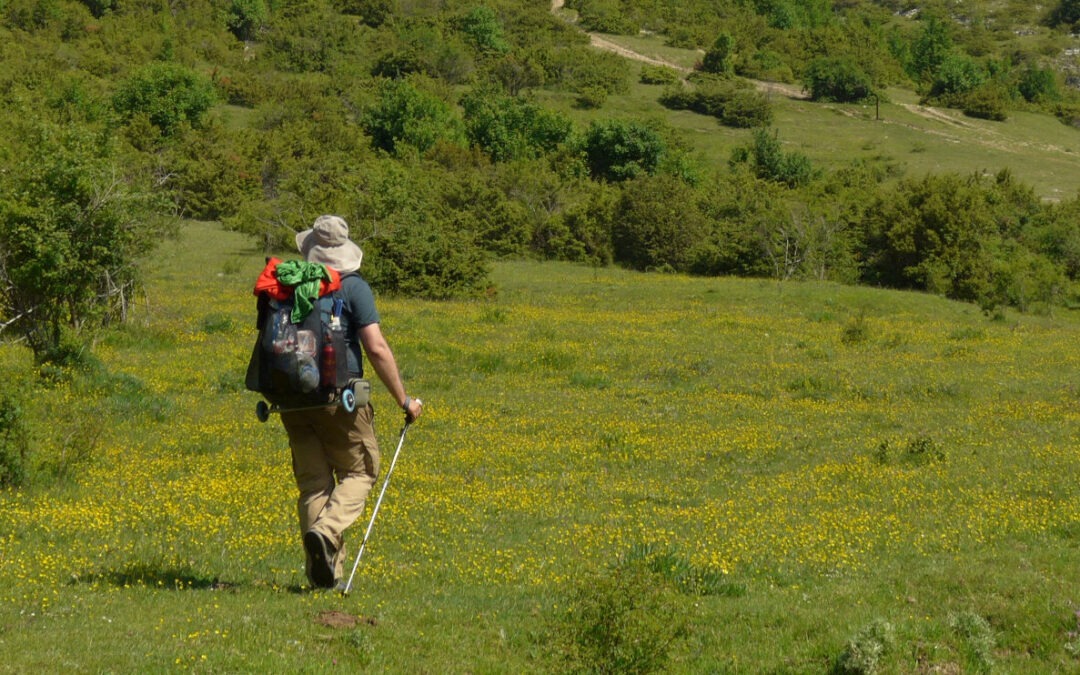
If you love hiking or want to get into it, you know how crucial the right clothes can be for a fantastic day out on the trails. It might be tempting to just wear your usual old jeans, a comfy T-shirt, and any old trainers, but with today’s technology, that’s like driving a car without air-con in the middle of summer. It works, sort of, but there’s definitely a better way.
In this post, I’ll explain the key points of good hiking clothes so you can put together the perfect hiking wardrobe for yourself. Remember, everyone is different, and in the end, you need to feel good and stay safe on your hike.
The Layering Principle
If you’ve ever chopped an onion, you’ll know this: an onion is neatly compact and round from the outside. Then you peel off a layer. And another. And then another layer. And yet another… In the end, you cut through the layers you need, finding only a tiny core in the middle.
As a hiker, you should assemble your clothing just like you’re an onion. By combining several different layers, you can finely tune your outfit to your needs in the moment, rather than trying to cram all functions into one or two layers.
For example, it’s better to take along a T-shirt and a light fleece instead of one thick fleece. This way, you can easily shed a layer when it gets too warm during a climb, without having to strip down to your underwear.
And if it suddenly gets chilly, you can add a layer. This is especially noticeable with jackets during transitional seasons. If you’re out with a thickly insulated jacket, you might find that the wind or rain forces you to wear it. But at the same time, you might be too warm from your activity or the sun, and you really need to take the jacket off. You’ll love being able to just put on the thin outer shell (whether it’s just a windbreaker or a rain jacket) and leave the insulation layer in your backpack.
The Essential Layers
If you want to apply the layering principle, you’ll generally encounter descriptions of three layers:
- the base layer
- the middle (or insulation) layer
- the outer layer
The Base Layer
 The base layer is worn directly against your skin and is designed to wick sweat away, ensuring dryness. This mainly includes underwear and undershirts, if worn. It’s crucial that this layer doesn’t absorb sweat and dries quickly. Traditional cotton underwear isn’t ideal for undershirts because while it’s comfortable on the skin, cotton absorbs moisture well and takes relatively long to dry. There’s little that can make you feel colder during a break than wet clothing on your skin.
For hiking, synthetic materials like polyester are usually a better choice, often preferred with silver ions to control odour. If you’re not sensitive, you might also try thin wool fabrics. They keep you warm even when damp, and very thin fabrics (with weights up to 200 g/m2 or about 6 oz/sqy) often dry quite quickly once they get the chance. However, they are generally more prone to holes and tears than synthetics.
The Middle Layer – The Insulation
 The middle layer provides insulation for the body and serves as additional thermal insulation. Here, you’ll find items typically used in ski underwear, such as leggings and tight-fitting pullovers, but also fleece jackets and similar warming garments.
While the base layer should wick sweat away from your skin to keep you dry, the insulation layer aims to move the sweat further out and primarily forms an air cushion around you that shields you from the external environment.
Merino wool has regained a solid place in the hiking apparel range in this layer. It can absorb up to 30% of its weight in moisture and still feel dry. Most people can wear wool for days without it smelling, which is a definite advantage if you’re not passing a washing machine daily and can’t carry countless spare T-shirts.
Icebreaker was one of the first manufacturers to bring merino wool back into fashion. Since then, many manufacturers have included merino tops and leggings in their ranges.
Nevertheless, fleece tops and ski underwear made from synthetics are also noteworthy. They are often equipped with silver ion technologies or other inventions to combat odour and often provide similar warmth to wool but at a lighter weight. Plus, they are usually more durable than their wool counterparts.
When it comes to precise choices, fleece jackets are generally superior to fleece pullovers in everyday life: if it’s too cold without fleece but too warm with it, you can wear the fleece jacket but leave it open or only partially zip it up. With a pullover, even one with a long zipper, you don’t have this option. And especially in the transitional seasons, you often find yourself in this odd hot-cold situation.
The Outer Layer – The Protective Shell
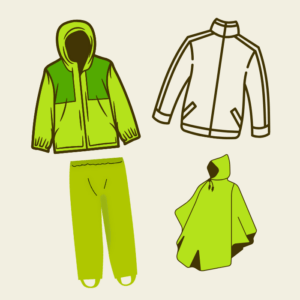 The outer layer has the toughest job of all. It needs to simultaneously:
- protect against rain and wind,
- shield you from brushes, rocks, and the ground when unavoidable,
- endure the friction from your backpack,
- prevent cooling and overheating,
- provide pockets for necessary small items along the way (and ideally keep them dry),
- wick away and evaporate sweat so you don’t end up ‘cooking’ in your clothes.
All in an easy days work…
Typically, the outer layer is divided into two parts. For everyday use, it usually involves a sturdy pair of hiking trousers with pockets and, if at all, a thin windbreaker. These often cover the durable outer shell with good ventilation and pockets.
When it rains, that’s when the rain gear comes out. For upper body protection, you can choose between a rain poncho and a rain jacket. For the legs, it boils down to a choice between rain trousers or a rain kilt plus gaiters. But I’ll write a separate article about rain protection, because enduring prolonged rain is an art in itself.
The outer layer is the only one where you might still find cotton today. It’s quite common in fabric blends for hiking trousers and sometimes jackets. Cotton makes the clothing a bit quieter than if it were made from pure synthetic material.
However, today it’s almost exclusively blends because cotton takes forever to dry once it’s thoroughly soaked. The jeans that got drenched on the first day of hiking in a heavy downpour will not dry properly for the rest of the hiking week unless you’re lucky enough to stay in a guesthouse with a dryer. Therefore, many modern trouser fabrics are cotton blends or entirely synthetic.
The same issue exists with wool. True wool loden is a fantastic companion once you get used to the weight. No softshell can match its wearing climate. But when loden gets thoroughly soaked, it becomes not only incredibly heavy but also takes almost longer than cotton to dry (and a dryer is not an option for loden). Thus, this natural material is better suited for day trips or shorter hikes with suitable weather.
For longer journeys or predictably rainy weather, modern synthetics with their high-performance membranes are the better choice. A quick-drying, ideally wind- and mosquito-proof pair of hiking trousers is a good foundation for many trips. And a well-fitting rain jacket with a high-performance membrane can make the difference between a relaxed hiking day despite the rain or an endless day as a wet, freezing cat.
3. Über den Einkauf
Wenn du anfängst, deine Wander-Garderobe zusammenzustellen, wirst du schnell feststellen, daß du locker ein kleines Vermögen ausgeben kannst, nur um dich mit den Basics einzukleiden. Jacken für 300-500€ sind keine Seltenheit und die anderen Teile sind im Vergleich zu den Preisen der Alltagsmode ebenfalls oft atemberaubend.
Für den Einstieg kannst du meist problemlos das nehmen, was du schon zur Hand und im Haus hast. Und den Rest suchst du dir einzeln zusammen. Und das lohnt sich. Eine leistungsstarke Wanderkleidung kann selbst Ausflüge mit durchwachsenem Wetter zu einem netten Tag werden lassen. Du erinnerst dich dann wahrscheinlich doppelt so gern an das Restaurant, wo du eingekehrt bist, den fast menschenleeren Aussichtspunkt, oder den Moment, an dem die Wolken aufreißen und die Landschaft wie frisch geschrubbt leuchtet. Und daß, ohne die unangenehmen Erinnerungen an das Gefühl von nass-kalter Katze oder offenen Blasen am Fuß.
Sobald du ein wenig Wandererfahrung hast, kannst du dich im Markt umsehen, welche Wanderjacken oder Wanderhosen dir das bieten, was du für deine Lieblingswanderungen brauchst.
Wo kaufe ich günstig Wanderkleidung?
Und sobald du weißt was du suchst, geht es in den immer größer werdenden Second-Hand Markt und du schaust, was du finden kannst. Zwei der großen Online-Secondhand-Plattformen mit recht vielen Angeboten an Wanderkleidung sind Momoxfashion und Vinted. Aber auch auf ebay Kleinanzeigen und vielen anderen Plattformen kannst du für Wanderkleidung auf Schnäppchenjagd gehen.
Vor Ort gibt es inzwischen auch immer mehr Outdoor-Händler wie Globetrotter, die in ihren Läden Secondhand-Bereiche haben, in die du immer einen Blick werfen kannst. Meist sind diese in der Nähe vom Eingang oder den Kassen.
Oder beobachtest die Schlussverkäufe mit ihren Rabatten. Dort kannst du Jacken, Hosen, Isolationsteile für teilweise den halben Preis ergattern. Und es ist ja auch okay, im Frühling die Skiunterwäsche des letzten Jahres zu kaufen. Du brauchst sie wahrscheinlich sowieso im nächsten Herbst. Und Socken brauchst du immer.
What labels should I look for when buying hiking clothes?
If you want to act especially responsibly, pay attention to the labels that matter to you. The most well-known currently include:
- Bluesign: This label sets high standards across the entire value chain of textile production, including resource productivity, consumer protection, water protection, emission control, and occupational safety.
- Fair Wear Foundation: This label focuses on improving working conditions in the countries of manufacture and is supported by many well-known manufacturers like Vaude and Schöffel.
- Öko-Tex Standard 100 and Made-in-Green by Öko-Tex: These certifications test products for harmful substances and ensure that the entire production chain is sustainable and socially responsible.
- Global Organic Textile Standard (GOTS): This globally recognized label guarantees that textiles are made from organically produced natural fibres and adhere to strict social criteria along the entire production chain.
- IVN BEST: Another strict label that sets high ecological and social standards, particularly regarding the use of natural fibres and adherence to ILO core labor standards.
These are the most well-known labels, often valid worldwide, but they are by no means all, as industry giants continue to invent more labels.
die wichtigsten Accessoires für Kopf und Füße
 Nachdem Oberteile und Hosen bedacht sind, dürfen natürlich die Enden vom Körper nicht vergessen werden: Kopf, Hände & Füße.
Denk daran Schuhe und Socken von guter Qualität zu tragen. Die Schuhe müssen in jedem Gelände gut an deinem Fuß sitzen und brauchen einen guten Grip auf unebenem Untergrund und Gestein. Bevorzugt auch dann, wenn die Wege nass sind.
Der beste Schuh nutzt aber wenig, wenn du keine guten Socken darin anziehst. Deine Wandersocken müssen gut sitzen, dürfen nicht rutschen (und blasenverursachende Falten werfen) und sind am Besten auch praktisch gepolstert. Die meisten Wandersocken sind inzwischen aus Merino-Kunststoff-Gemischen oder pur aus Synthetikfasern.
Falls du mit Wanderschuhen oder Trailrunnern unterwegs bist und ständig Steinchen im Schuh findest, dann können Mini-Gamaschen vom Typ Dirty Gaiter für dich interessant sein. Sie decken den Übergang von Schuh zu Socke ab und halten die lästigen Steinchen draußen.
Für deinen Kopf brauchst du einen Sonnenhut und Sonnenbrille. Der Sonnenhut sollte entweder ernsthaft sicher sitzen oder hat ein Sturmband, damit ihn nicht jede Windböe vom Kopf fegt.
Wenn du in den kälteren Monaten unterwegs bist oder in kühle Höhen aufsteigst, gehören auch Mütze, Schal und Handschuhe in den Rucksack.
The right hiking attire can make a significant difference between hiking joy and hiking frustration. Gaining experience and gradually putting together the right wardrobe for yourself is a small but rewarding adventure on its own. And if you have the right clothes but are still wondering what gear you need for a day trip, you can read on there. Or maybe you’re planning a day trip but don’t quite have a plan yet? Then continue reading here.
Happy hiking!