
Featured-Image by Ainars Djatlevskis on Unsplash
Ireland, the Emerald Isle, entices with its breathtaking nature, historic trails, and rich culture. From gentle hills and mystical moors to majestic coastal cliffs, Ireland offers hikers unforgettable experiences. In this article, you will learn everything you need for a successful hiking trip in Ireland – from the best routes and the right gear to practical travel tips.
Note: Some of the links on this website are affiliate links (marked with *). This means that we receive a small commission if you make a purchase through these links – at no extra cost to you. This helps us run the website and continue to provide high-quality content. Thank you for your support!
Ireland generally has a year-round hiking climate, thanks to the Gulf Stream in the Atlantic, which keeps winters mild and summers cool with refreshing breezes. However, it also brings plenty of rain.
The best time to explore Ireland’s beautiful landscapes is from April to October. These months offer the best weather, longer days, and less rain. In the west of the island, May and June are often the driest months and also have the longest days – perfect for hiking.
Autumn and winter are less ideal for longer hikes in the mountains or along the coast. During these seasons, storms are more frequent, and it rains more consistently, making trails muddy or dangerously slippery. It’s best to avoid exposed and hazardous paths during this time.
The Hiking Trails in Ireland
How many hiking trails are there in Ireland?
Even though some hiking trails in Ireland have been around for many decades, Ireland is still slowly developing as a prime hiking destination. The network of trails is expanding and improving, but it will take time before a comprehensive network covers the island.
Nevertheless, there are routes for all fans of coasts, moors, and hills. Mountain enthusiasts may not be fully satisfied, as Ireland’s highest peak is just over 1000 meters (3280 feet) high, and most mountains are more like rounded hills. You will still work up a sweat on your way up before enjoying the view. Currently, you can choose from an estimated 4000 – 5000 km (2400 – 3100 miles) of hiking trails.
Almost all long-distance trails in Ireland are marked with a yellow walker symbol and a yellow arrow on a black background. Where hiking trails are recorded and signposted, the signs often also indicate distance and difficulty level.
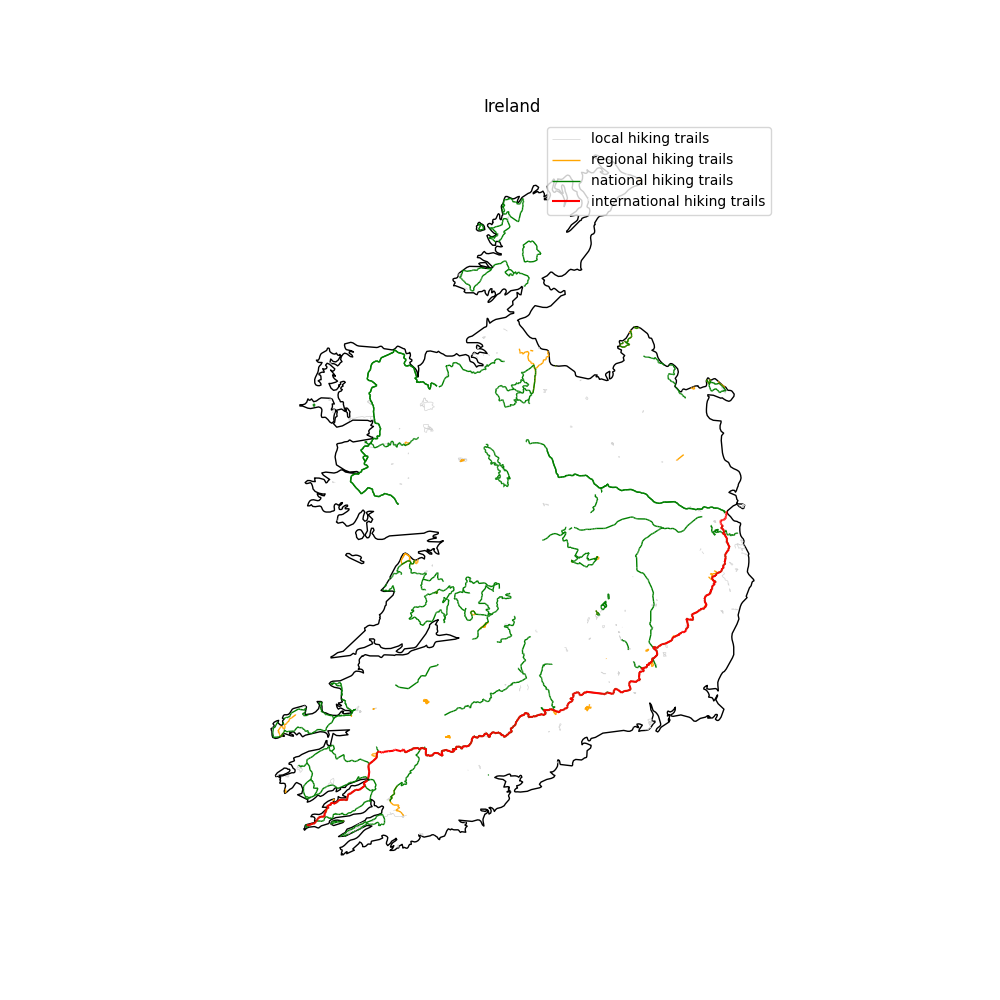
Analysis of the hiking trails in Ireland entered in the OSM database.
The Most Popular Hiking Trails in Ireland
Some of the best and most well-known hiking trails in Ireland are:
Wicklow Way
- Start/End Point: Marlay Park (Dublin) / Clonegal (County Carlow)
- Total Length: 131 km (81 miles)
- Number of Stages: 7
- Stage Length: 15-23 km (9-14 miles)
- Best Hiking Time: May to September
- Luggage Transport: Yes, e.g., Wicklow Way Baggage
- Experience Level: Intermediate
- Camping: Limited, use official campsites
- More Info: Wikipedia – Wicklow Way
The Wicklow Way is one of the oldest and most famous long-distance trails in Ireland. It traverses the scenic Wicklow Mountains, offering breathtaking views of dense forests, sparkling lakes, and historic monasteries. Highlights include the Powerscourt Waterfall and the monastic site of Glendalough. The Wicklow Way is also part of the E8 European long-distance path.
Kerry Way
- Start/End Point: Killarney / Killarney
- Total Length: 214 km (133 miles)
- Number of Stages: 9-11
- Stage Length: 15-25 km (9-15 miles)
- Best Hiking Time: April to October
- Luggage Transport: Unknown
- Experience Level: Intermediate
- Camping: Good opportunities at campsites
- More Info: Kerry Way
The Kerry Way circles the beautiful Iveragh Peninsula, offering spectacular coastal landscapes, green valleys, and historical sites. Highlights include the Gap of Dunloe, the Black Valley, and Ladies View. The well-maintained trail passes through one of Ireland’s most scenic regions, providing numerous opportunities to observe local flora and fauna.
Dingle Way
- Start/End Point: Tralee / Tralee
- Total Length: 179 km (111 miles)
- Number of Stages: 8
- Stage Length: 20-25 km (12-15 miles)
- Best Hiking Time: May to September
- Luggage Transport: Yes, e.g., Dingle Way Baggage Transfer
- Experience Level: Intermediate
- Camping: Available, prefer official campsites
- More Info: Dingle Way
The Dingle Way takes you along the picturesque coasts of the Dingle Peninsula. The route offers stunning views of the Atlantic, steep cliffs, and historic sites such as the Gallarus Oratory. The hike combines coastal paths, hill tracks, and rural roads passing through charming villages. Particularly impressive are the beaches and the rocky coastal sections.
Beara Way
- Start/End Point: Glengarriff / Kenmare
- Total Length: 220 km (137 miles)
- Number of Stages: 9-12
- Stage Length: 15-23 km (9-14 miles)
- Best Hiking Time: April to September
- Experience Level: Intermediate
- Camping: Good opportunities at campsites
- More Info: Beara Tourism
The Beara Way traverses the lesser-visited yet highly scenic Beara Peninsula. The route offers breathtaking coastal landscapes, ancient copper mines, and rich wildlife. Highlights include the Dursey Island cable car and the Healy Pass. This hike combines spectacular views with cultural and historical sites.
Sheep’s Head Way
- Start/End Point: Bantry / Bantry
- Total Length: 93 km (58 miles) (including all loops and extensions)
- Number of Stages: 6
- Stage Length: 10-20 km (6-12 miles)
- Best Hiking Time: May to September
- Experience Level: Intermediate
- Camping: Limited, use official campsites
- More Info: Hillwalk Tours – Sheep’s Head Way
The Sheep’s Head Way offers stunning views of Bantry Bay and the Mizen Peninsula. The route is known for its unspoiled nature and peaceful atmosphere. Hikers enjoy quiet paths along the coast and through charming villages. This hike is perfect for those seeking a quiet and picturesque walk off the beaten path.
Burren Way
- Start/End Point: Lahinch / Corofin
- Total Length: 114 km (71 miles)
- Number of Stages: 5
- Stage Length: 20-25 km (12-15 miles)
- Best Hiking Time: May to September
- Experience Level: Intermediate
- Camping: Good opportunities at campsites
- More Info: Hillwalk Tours – Burren Way
The Burren Way leads through the unique karst landscape of the Burren in County Clare. The route features impressive limestone landscapes, rare flora, and the famous Cliffs of Moher. This hike is ideal for nature enthusiasts who wish to discover unique geological formations and a diverse plant life.
Book Corner for these hiking trails
Her you find the walking guides for these trails, that I could discover and seem reasonable:


Hiking Festivals
If you enjoy company while hiking, you should check out one of the many hiking festivals in Ireland. These events are not just about the destination but the journey itself, allowing you to meet like-minded people and gather great ideas for your next adventure. Here are a few examples:
Wicklow Walking Festival
- Location: Wicklow Mountains, County Wicklow
- Time: October
- More Info: walkinghikingireland.com
The Wicklow Walking Festival is one of the most well-known hiking festivals in Ireland, offering hikers the chance to explore the breathtaking landscapes of the Wicklow Mountains. The festival features a variety of guided walks for different experience levels, from leisurely strolls to challenging mountain hikes. It also includes workshops and talks on local flora and fauna.
Killary Fjord Walking Festival/Connemara Mountain Walking Festival
- Location: Killary Harbour, Connemara, County Galway
- Time: April/May
- More Info: Connemara Mountain Walking Festival
The Killary Fjord Walking Festival takes place in the stunning region of Connemara and offers hikes with spectacular views of Killary Fjord. The festival provides guided walks suitable for both beginners and experienced hikers. The routes cover some of Ireland’s most beautiful and wild landscapes, including mountains, coasts, and valleys.
Burren Slow Food Festival
- Location: Lisdoonvarna, County Clare
- Time: May
- More Info: Galway Tourism – Burren Slow Food Festival
Although primarily a food festival, the Burren Slow Food Festival also includes a range of walks and hikes through the unique karst landscape of the Burren. Participants can enjoy local cuisine while exploring the stunning scenery. Guided walks combine culinary experiences with the exploration of the region’s diverse flora and fauna.
Where Can You Sleep While Hiking?
In Ireland, you’ll find many Bed & Breakfasts (B&Bs). These small guesthouses with breakfast are often well-prepared for hikers along long-distance trails. If there’s no restaurant or pub nearby, they often offer dinner as well. They come in all price ranges and many can be found on usual booking sites.
In larger towns, you’ll usually find hotels, and if you like a bit of glamour (and can afford it), you can stay in one of the castles or manor houses that are sometimes located near the trails.
For a more robust and affordable option, pubs with accommodation are a great choice, where you don’t even have to leave the building for dinner. And if you’re looking to save money, staying in a youth hostel like those from An Óige, the Irish Youth Hostels Association, is a good option.
For camping enthusiasts, there are plenty of campsites throughout the country. Wild camping is officially prohibited but is sometimes tolerated in remote areas. Always ask the landowner for permission if possible and leave no trace.
In the mountains, you might occasionally find bothies, similar to those in Scotland. However, they are rare, so it’s best to research in advance to see if there are any along your planned hiking route and if they are still in use.
What Equipment Do You Need?
For hiking in Ireland, you’ll need the usual trio of good shoes with a sturdy grip, durable, quick-drying hiking clothes, and a good backpack. And of course:
Rain gear!
Ireland is one of those countries where you can thoroughly test your rain equipment unless you catch one of the rare long sunny spells. You’ll also learn if your backpack is waterproof and how quickly your gear dries when it gets thoroughly soaked. The Irish weather is indeed a strong teacher. But it’s also beautiful when you’re well-prepared, and you’re outside when the clouds break, rainbows span the landscape, and the colours really come to life. That’s another thing about Ireland: if you don’t like the weather, just wait a bit. It will probably change soon.
In addition, good navigation tools should be in your backpack. While the trails are usually well-marked and visible, you can easily find yourself in situations where rain or fog limits visibility for a while. Then, it’s easy to end up on the wrong path or off the trail entirely. Being able to orient yourself at all times and having a backup for a dead phone battery is essential.
How to Replace or Add Gear?
If some of your gear breaks or gets lost while you’re hiking in Ireland, all is not lost. Especially in larger towns, you’ll find outdoor stores like Cotswold Outdoor or Outdoor Adventure Store. You might also come across a Decathlon. In areas popular with tourists, you can also find smaller specialist shops.
If you can’t find what you need locally, you can check the two major Irish online retailers, 53 Degrees North or Outdoor Adventure Store (the online shop for their city branches). Both offer fast shipping and have a good selection of gear.
The main parcel delivery services are An Post (the Irish postal service) and DHL. Both are known for being reliable and fast, with deliveries within 1-3 working days inside the country (overnight for express services).
An Post has post offices and parcel shops throughout the country, which are accessible to tourists (check the opening hours in advance!). DHL has parcel shops mainly in larger towns. It might be a good idea to ask one of your future accommodations if you can have a package sent to them so that it will be there when you arrive.
Provisions: How to Supply Yourself with Food on Your Hike
Unless you get a packed lunch from your B&B or hotel, the best way to stock up on provisions in Ireland is at supermarkets in larger towns along the trail. Chains like Tesco or Lidl are often open from 8 am to 10 pm. They are usually only closed on major holidays (bank holidays) like St. Patrick’s Day in March, Easter Monday, and Christmas.
In smaller towns, you might come across small local shops, usually open from 9 am to 6 pm and sometimes on Sundays after church.
With some luck, you may find a market with fresh produce in towns. These markets are typically held on Saturdays and sometimes on Wednesdays.
If all else fails, try to find a larger petrol station. They often have attached small convenience stores where you can find something to eat 24/7.
For hot meals, as mentioned, B&Bs and hotels often provide them if they have a kitchen. Otherwise, you can find meals in the famous pubs or sometimes in cafés and tea rooms in smaller towns.
Lunch is usually served from 12:00 pm to 2:30 pm, and dinner from 6:00 pm to 9:00 pm. Pay special attention to Sundays and holidays, as many restaurants and cafés are closed, and even if pubs are open, their kitchens may not be.
Drinking – Tips for Water Supply on the Go
In Ireland, tap water is generally safe to drink. In rare cases, particularly in rural areas, there might be outdated systems, but you will usually be informed if this is the case.
You can usually refill your water in B&Bs, hotels, or pubs along the way.
If you need to rely on surface water, it is generally plentiful. However, always use good filters to protect yourself from contaminants left by grazing animals.
If your route takes you through agricultural areas, it’s better to use tap water or water bought from supermarkets. Some pollutants from agriculture or industrial waste cannot be removed by portable filters.
Quick Info for Travel to Ireland
Language: English
Communication: Primarily English. Irish (Gaelic) is also spoken, but most speakers also understand and speak English. Irish English can be tricky to understand at times, but usually you shouldn’t encounter any real problems.
Currency: Euro
Payment Methods: Mostly credit card (Visa/Mastercard), but cash up to €50 is still widely used. Modern payment methods are slowly becoming more common, primarily in cities and slowly in rural areas.
Time Zone: Central European Time (CET) -1 hour (i.e., when it is 12 pm in Central Europe, it is 11 am in Ireland)
By Air: International flights mainly arrive in Dublin. Cork, Kerry, and Ireland West Airport Knock are more regional.
By Ferry: You can take a ferry from France or the UK. The main ports in Ireland are Cork, Rosslare, and Dublin.
By Train and Coach: Most connections go through London with onward travel to Dublin.
Important Note!: If your travel involves transit through the UK (e.g., London), you need a passport. For direct travel to Ireland, a personal ID card is sufficient.
Ireland has a well-developed public transport system consisting of trains and buses. Ferries complement some routes. Trains mainly connect larger cities, while buses reach almost every small village.
You can plan and compare your travel routes within Ireland with the National Journey Planner.
Ireland uses 230V as most of the rest of Europe. The sockets are very different though, so you will likely need a travel adapter for Ireland (Type G). It is common to have sockets with individual switches. If a socket isn’t working, check for a small switch on it.
There is no real need to think about carrying renewable energy devices. As wild camping is prohibited, you will likely stay in accommodations regularly to dry off, where you can charge your devices.
It’s useful to bring a multi-plug (either to charge multiple devices simultaneously or to share a socket with others) and enough power bank capacity to get through a day or two without access to power.
Safety & Emergencies
In general, Ireland is considered a very safe travel destination for hikers. Of course, you should keep an eye on your belongings, as pickpockets can be active in tourist hotspots, and more or less accidental mix-ups of gear in larger accommodations can happen. But you can generally feel very safe in Ireland.
There are also few dangers from the local wildlife and plants. Keep a respectful distance from grazing animals and don’t pick plants you can’t positively identify, and you should be fine.
Unfortunately, Giant Hogweed has made its way to Ireland, as it has across much of Europe. If you stay away from these towering plants (up to 5m tall and 1.5m wide), you’ll be safe. Its sap can cause severe skin burns that make stinging nettles look like baby toys. You’d have to harm the plant though, to get the sap on your skin. There’s also the native Hogweed, which only grows up to 2m tall and is harmless, so don’t panic at every large plant you see.
Due to the weather, it is important to let someone know where you are going and when you expect to arrive, so that rescue services can be alerted if things go wrong badly.
In an emergency, you can reach the emergency services in Ireland by calling the Europe-wide 112 or the local 999. The rescue services are generally well-organised and experienced, and medical care in Ireland is considered good. Just make sure you have your EHIC card and possibly travel insurance with you.
Where Can You Find More Information About Hiking in Ireland?
On www.ireland.com, you can find plenty of inspiration and practical information for hikers, as well as general information about Ireland and travelling there.
You’ll also find great information about easy hikes on Discover Ireland and more challenging tours on Mountaineering Ireland, while the trails themselves are mostly listed on Sport Ireland.
Book Corner
Here are a few books about hiking tours in Ireland in general, along with an additional hiking trail.
Your hike through Ireland is sure to be an unforgettable experience, with its stunning landscapes and the warm hospitality of the Irish people. If you’re looking for more adventures, why not explore our articles on hiking in the UK and France? Both countries offer amazing trails and beautiful natural scenery.
Happy hiking!